


Historically
The Brontës
The Brontës
Couldn't load pickup availability
Wild as the Moors.
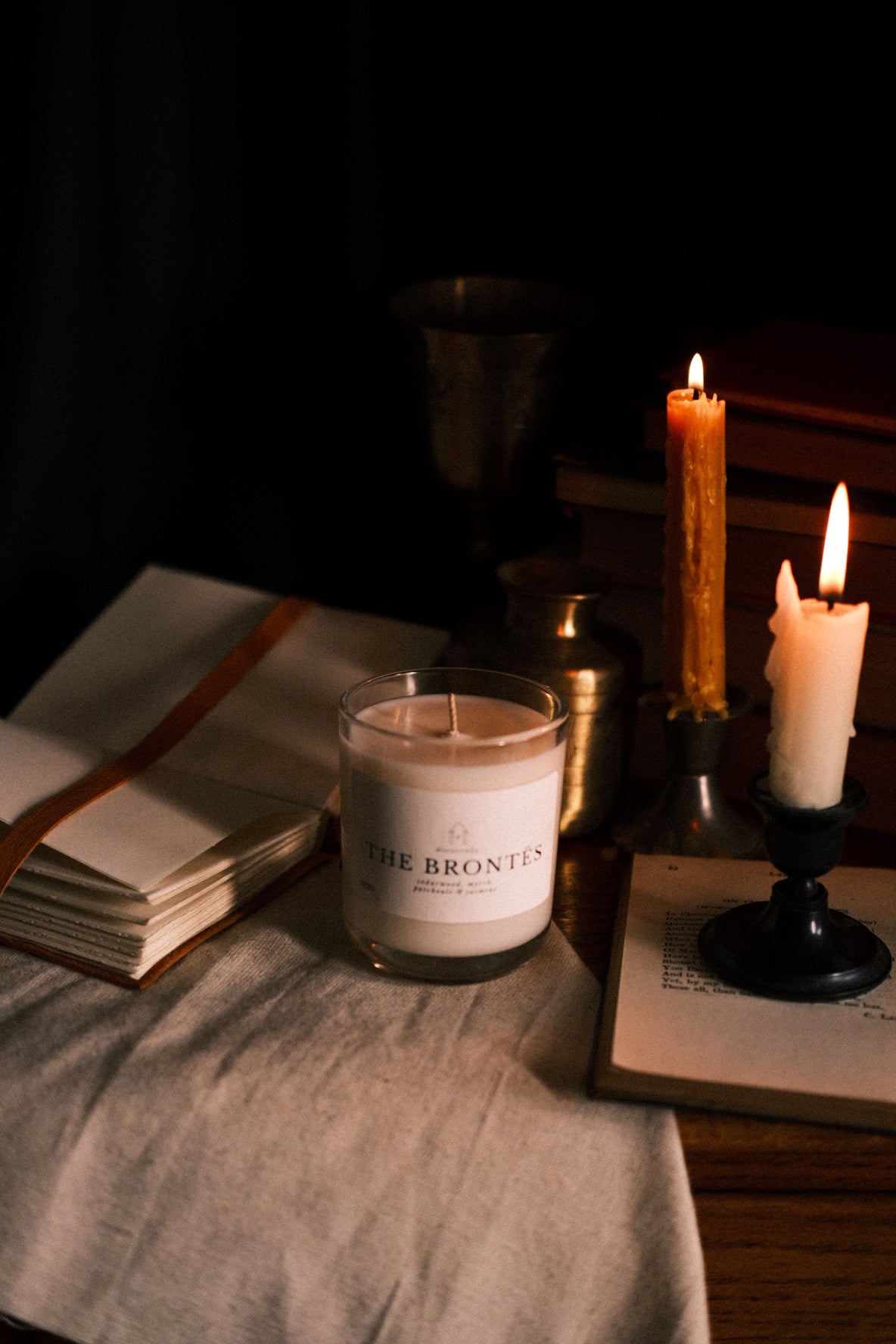
Inspired by the Brontë family and the harsh Yorkshire landscape they called home. Cedarwood and patchouli evoke windswept moors and earth, while jasmine softens the shadows with warmth. Myrrh recalls Victorian medicines, used in mouthwashes and remedies for ailments including tuberculosis. Beneath it all lies the comfort of the parsonage, reams of paper and ink, cherished family moments, and the tragedy that would ultimately consume them.
170g/400g
Up to 40/100 hours of burn time
Recyclable glass vessel
100% Sustainable and natural soy wax
Essential Oil Blend
Vegan and free from animal cruelty
Made in the UK
Share
Scent Inspiration
Scent Inspiration
Inspired by the harsh Yorkshire moors, this scent is as warming as it is wild to represent cherished moments within the Brontë family home, reems of paper and ink, and the misfortune that befell the family in the end.
History behind the Woman
History behind the Woman
Few families have left such a profound mark on English literature as the Brontë sisters. Their novels continue to captivate readers with their emotional depth, unforgettable characters, and remarkable insight into the human condition. Writing from the remote Yorkshire moors, Charlotte, Emily, and Anne Brontë transformed personal experience, imagination, and quiet determination into some of the most celebrated works in literary history.
Born into the household of the Reverend Patrick Brontë in the village of Haworth, the sisters experienced both privilege and profound loss from an early age. The deaths of their mother and two elder sisters left a lasting impression on the family, while the wild landscapes surrounding the parsonage became an enduring source of inspiration. The sweeping moorland, dramatic skies, and changing seasons would later echo through the pages of their novels, becoming almost characters in their own right.
Despite receiving only limited formal education, the Brontë sisters cultivated extraordinary intellectual lives. Together with their brother Branwell, they created intricate imaginary kingdoms, filling notebooks with stories, poems, and histories. These youthful literary worlds allowed them to develop their distinctive voices long before they sought publication. In an age when women's creative ambitions were often dismissed, the sisters pursued their craft with remarkable discipline and quiet confidence.
The literary world of nineteenth century Britain offered few opportunities for women to be taken seriously. To overcome prejudice, Charlotte, Emily, and Anne adopted the masculine pen names Currer, Ellis, and Acton Bell. Their decision reflected the realities of Victorian publishing, where a woman's writing was often judged by assumptions about her gender rather than the quality of her work. Even behind pseudonyms, however, the originality of their novels quickly became impossible to ignore.
Charlotte Brontë achieved widespread acclaim with Jane Eyre, a novel that challenged conventional ideas of femininity, morality, and social class. Through the determined and fiercely independent Jane, Charlotte presented a heroine whose intelligence and moral conviction resonated with readers across generations. The novel demonstrated that a woman's inner life could provide the foundation for a powerful and enduring work of literature.
Emily Brontë's Wuthering Heights proved even more unconventional. Initially met with confusion by some critics, its exploration of passion, revenge, obsession, and the untamed power of nature has since secured its place among the greatest novels in the English language. Emily's singular imagination produced a work unlike anything published in its time, one whose emotional intensity continues to fascinate readers around the world.
Anne Brontë, often the most overlooked of the three sisters, brought a distinctive realism to her writing. Agnes Grey drew upon her own experiences as a governess, while The Tenant of Wildfell Hall confronted issues such as alcoholism, domestic abuse, and a woman's right to independence with extraordinary courage. Its honest portrayal of an unhappy marriage challenged Victorian sensibilities and established Anne as one of the period's most progressive literary voices.
Tragically, the sisters' literary careers were brief. Branwell, Emily, and Anne all died within a short period, victims of illness that devastated the family. Charlotte lived only a few years longer, dying in 1855 at the age of thirty eight. Although their lives were marked by personal sorrow, the body of work they created within such a short span remains one of the most remarkable achievements in British literary history.
The Brontë sisters did more than write memorable novels. They expanded the possibilities of literature by placing women's experiences, emotions, and aspirations at the heart of their stories. Their characters possessed complexity, resilience, and moral depth, offering readers a richer understanding of both society and the individual.
Scent Notes
Scent Notes
cedarwood, myrrh, patchouli & jasmine
Cedarwood:
Cedarwood has been prized since ancient times, particularly in the Middle East, where the famous Cedars of Lebanon were used to build temples, palaces, and ships. The Egyptians also used cedarwood oil in embalming and religious ceremonies because of its preservative qualities and rich aroma. Although cedar trees are not native to Britain, cedarwood oil and timber were imported from the medieval period onwards. By the Georgian and Victorian eras, cedarwood was valued in Britain for fine furniture, chests, and wardrobes, where its natural insect repelling properties protected clothing and linens.
Myrrh:
Myrrh, a fragrant resin obtained from trees native to northeast Africa and the Arabian Peninsula, has been used for over 5,000 years. It was highly prized in ancient Egypt for embalming, incense, and medicine, while the Greeks and Romans valued it for perfumes and healing balms. In Britain, myrrh arrived through medieval trade routes and became an important ingredient in church incense, particularly before the Reformation. It was also used by apothecaries for treating wounds and infections.
Patchouli:
Patchouli is native to Southeast Asia and has been cultivated for centuries in India, China, and Indonesia. Its aromatic leaves were traditionally used to perfume textiles and repel insects during transport. Patchouli became known in Britain during the 19th century when Indian cashmere shawls arrived wrapped in patchouli leaves, their distinctive scent becoming associated with luxury and authenticity. Victorian perfumers quickly adopted the oil, and it later gained renewed popularity during the 1960s.
Jasmine:
Jasmine originated in Asia, particularly India, China, and Persia, where it has been cultivated for thousands of years. In India, jasmine flowers have long been used in religious ceremonies, perfumes, and garlands. The plant reached Britain during the 16th and 17th centuries through expanding trade networks and quickly became popular in the gardens of wealthy estates and conservatories. During the Victorian era, jasmine was celebrated for both its intoxicating fragrance and ornamental beauty.
Safety Information
Safety Information
Contains Caryophyllene, Isoeugenol. May produce an allergic reaction.


Frequently Asked Questions
Candle Care
I. Keep candles away from curtains, fabrics, furniture, and draughts.
II. Avoid placing candles under shelves; maintain a 3-foot (1-meter) clearance above.
III. Prevent contact with clothes and hair; place candles out of reach.
IV. Keep children and pets at a distance from candles.
V. Maintain at least 4 inches (10cm) between burning candles.
VI. Extinguish before moving; avoid objects falling into hot wax.
VII. Never leave burning candles unattended.
VIII. Safely extinguish with a snuffer or spoon, not by blowing.
IX. Double-check to ensure candles are completely out.
Delivery & Returns
Dispatch times
Our candles are made to order and most will take between 3-5 business days to dispatch but this can extend up to 7 business days during busy periods.
However, if you are wanting your order sooner or for a specific date please get in touch and we can sort something out for you!
Delivery Times
We currently offer standard delivery with Royal Mail Tracked 48 which should arrive between 2-3 days after dispatch and express delivery with Royal Mail Tracked 24 which should arrive between 1-2 days after dispatch.
Shipping outside the UK
We are unable to ship to the EU and USA at this time.
Please do get in contact with us if you would like an order delivered outside of the UK and we will let you know if this is possible and what shipping charges will be. If it is possible we will calculate the shipping costs for you and complete your order via invoice.
Please note that customers are responsible for paying any import VAT, taxes and fees.
What is your return policy?
Please note earrings cannot be returned and refunded for hygiene reasons.
We are happy to accept returns if you are unhappy with your purchase.
Contact us within 14 days of delivery
Dispatch items back within 30 days of delivery
Request a cancellation within 24 hours of purchase (this is only possible if you haven't recieved a dispatch email)
Buyers are responsible for return postage costs. If the item is not returned in its original condition, the buyer is responsible for any loss in value.
Item damaged in transit
Sometimes accidents happen.
If you receive a parcel that has been damaged in the post please send a picture to us showing the damage within 48 hours of your parcel being delivered and we can discuss options with you.
- 5 stars: 1 (100%)
- 4 stars: 0 (0%)
- 3 stars: 0 (0%)
- 2 stars: 0 (0%)
- 1 star: 0 (0%)
Lovely candle, vey pleased with the quality and gorgeous fragrance. Highly recommend!