


Historically
Sophia Duleep Singh
Sophia Duleep Singh
Couldn't load pickup availability
The Indian Princess suffragette.
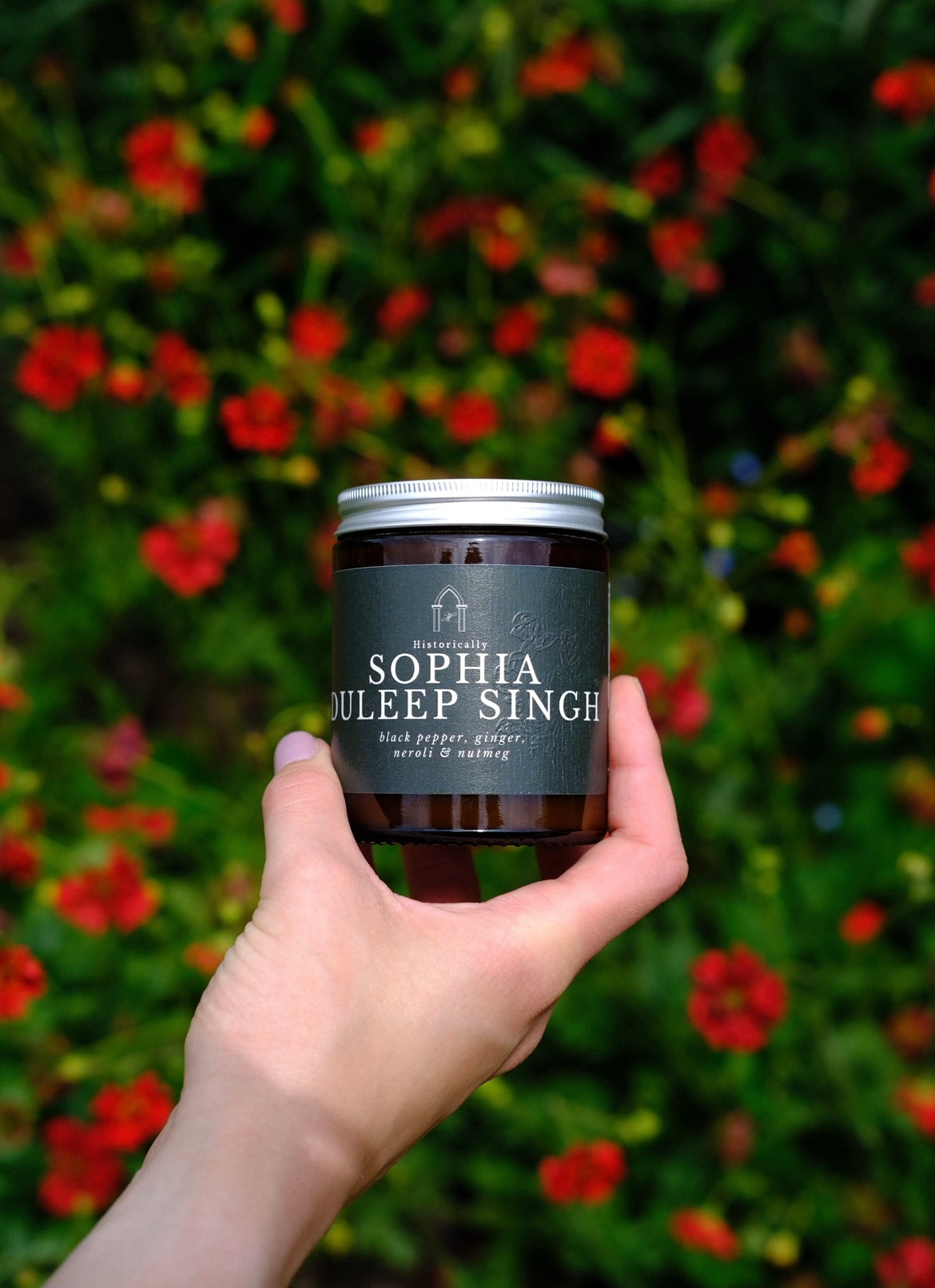
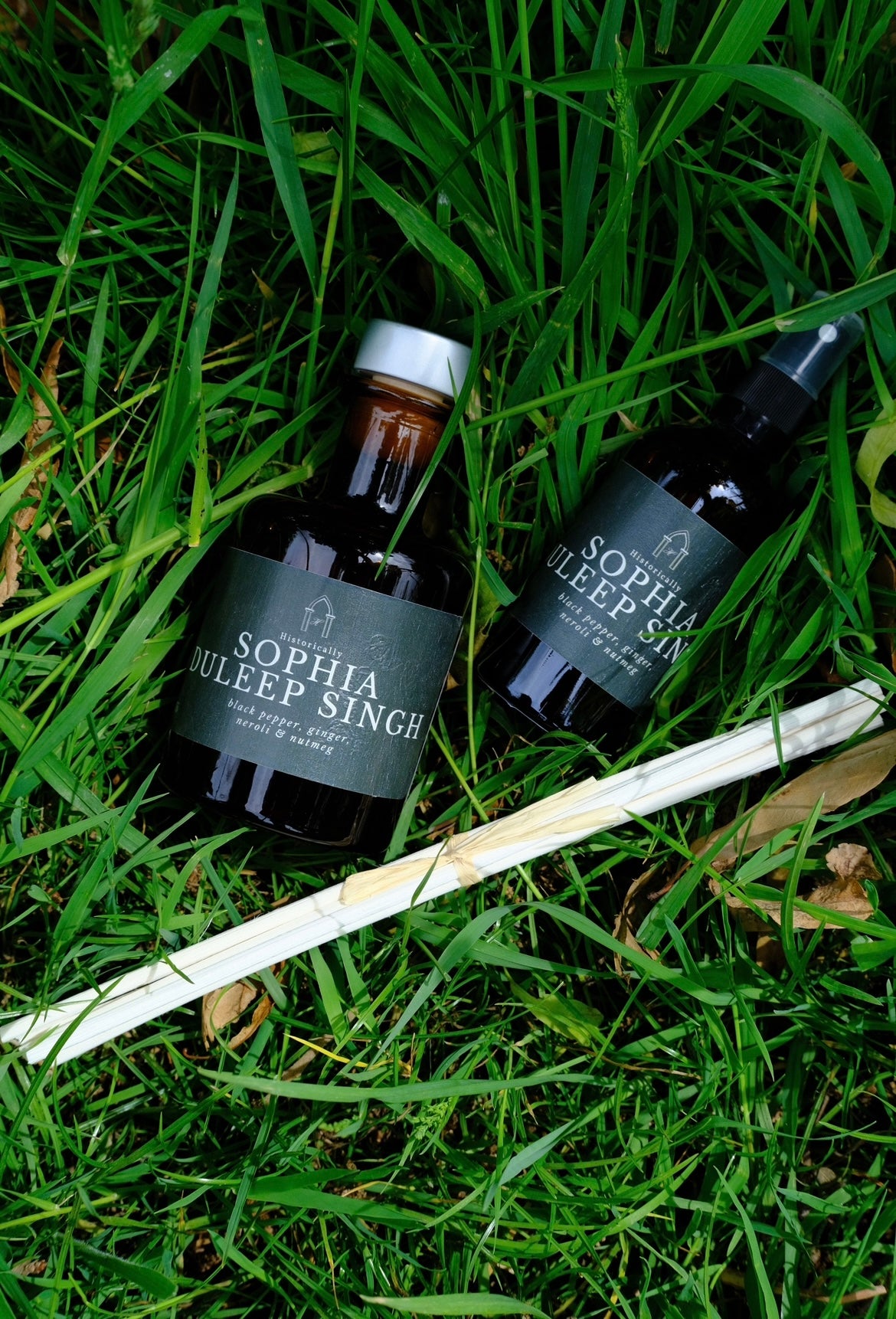
A scent as vibrant and commanding as Sophia Duleep Singh herself, a prominent suffragette, this candle infuses the vibrant spark of black pepper with invigorating ginger, whilst merging with the soothing undertones of neroli and warm nutmeg. Each note is a tribute to her spirited campaign for equality, blending the rich traditions of her Indian lineage with her fierce advocacy in Britain’s suffrage movement.
160g/400g
Up to 40/100 hours of burn time
Recyclable glass vessel with aluminium lid
100% Sustainable and natural soy wax
Essential oil blend
Vegan and free from animal cruelty
Made in the UK
Share
Scent Inspiration
Scent Inspiration
For Sophia we have been inspired by her Indian heritage and her life in Victorian Britain. Warm spices, such as black pepper, ginger and nutmeg were widely used in Indian cooking and Ayurvedic medicine for centuries not only for their aromatic qualities but also in aiding digestion and inflammation. Neroli on the other hand, was a luxury fragrance used in perfumes and cosmetics during the Georgian and Victorian period and very well may have been a scent she might have used herself.
History behind the Woman
History behind the Woman
In the long and often contested struggle for women’s rights in Britain, few figures embody the intersection of privilege, defiance, and political conviction as vividly as Sophia Duleep Singh. Her life traces a remarkable journey from aristocratic upbringing to radical activism, revealing how personal awakening can transform inherited status into a platform for change.
Born into royalty, Sophia was the daughter of Maharaja Duleep Singh, the last ruler of the Sikh Empire, and a goddaughter of Queen Victoria. Raised in Britain within the orbit of the royal court, she grew up surrounded by wealth, ceremony, and expectation. At first glance, her position seemed secure and conventional, defined by loyalty to crown and empire. Yet beneath this polished exterior lay the beginnings of a more questioning mind.
A pivotal transformation came with her travels to India, where she confronted the realities of British colonial rule and the legacy of her own family’s dispossession. These experiences reshaped her understanding of identity and justice. No longer content to remain a passive figure within aristocratic society, Sophia began to align herself with causes that challenged the very structures that had once defined her life.
Her involvement with the women’s suffrage movement marked the most visible and enduring chapter of her activism. Joining the Women’s Social and Political Union, she became part of a movement that rejected patience in favour of direct action. The suffragettes sought not gradual reform, but immediate recognition of women’s right to vote, and they were willing to confront authority to achieve it.
Sophia’s protest was both symbolic and practical. From her residence at Hampton Court, she staged demonstrations that were impossible for the establishment to ignore. She sold suffragette newspapers, confronted politicians, and publicly refused to pay taxes, declaring that a government which denied her representation had no claim to her money. Her defiance was not merely rhetorical. It was enacted in full view of a society unaccustomed to seeing a woman of her status engage in such acts of resistance.
Her position as both an insider and an outsider gave her activism a unique resonance. As a member of the British elite, she could not easily be dismissed. As a woman of Indian heritage, she carried the complexities of empire within her own identity. In Sophia, questions of gender, race, and power converged, highlighting the broader injustices embedded within the imperial system.
The outbreak of the First World War shifted the strategies of many suffragettes, but Sophia’s commitment to service did not waver. She contributed to the war effort by supporting Indian soldiers, working as a nurse and fundraiser, and advocating for those who had been drawn into a conflict far from home. Her actions reflected a continued dedication to both her heritage and her adopted country, even as she challenged its inequities.
The eventual extension of voting rights to women in Britain did not arrive overnight, nor was it the result of a single voice. It was the culmination of sustained pressure from countless individuals who refused to accept exclusion. Sophia Duleep Singh stands among them as a figure of particular distinction, not only for her courage, but for her willingness to transform privilege into purpose.
Her life resists simple categorisation. She was neither solely a princess nor solely a protester, but a complex individual who navigated both worlds with determination. In doing so, she expanded the possibilities available to women of her time and helped to redefine the boundaries of political participation.
Scent Notes
Scent Notes
Black pepper, ginger, neroli & nutmeg
Black Pepper (Piper nigrum)
Black pepper, native to India’s Malabar Coast, has been used in Indian cooking and Ayurveda for over 2,000 years, valued for both flavor and digestive benefits. It reached Britain during the Roman period and became highly prized in medieval times, often used as a status symbol and even as currency. British demand for pepper helped drive global exploration and trade, particularly through the East India Company, which imported it in large quantities. Over time, pepper became affordable and is now a staple seasoning in British cuisine.
Ginger (Zingiber officinale)
Ginger originated in Southeast Asia and has long been widely used in India in cooking and Ayurvedic medicine for digestion and inflammation. It was introduced to Britain by the Romans and became especially popular in medieval England, where it was used in both savory dishes and sweets. Gingerbread, in particular, became a traditional British treat during the Tudor period. As trade expanded under British colonial influence, ginger became more accessible and remains a common ingredient in British baking, teas, and home remedies today.
Neroli (from Citrus aurantium)
Neroli oil, derived from the blossoms of the bitter orange tree, originated in the Mediterranean and became fashionable in Europe in the 17th century. While bitter orange and related citrus plants were cultivated and used in India—primarily for culinary and medicinal purposes—neroli oil itself was not traditionally a major part of Indian practice. In Britain, neroli gained popularity during the Georgian and Victorian eras as a luxury fragrance used in perfumes, cosmetics, and scented products. It was associated with refinement and calm, and continues to be used in high-end British perfumery and aromatherapy.
Nutmeg (Myristica fragrans)
Nutmeg, native to the Banda Islands of Indonesia, has been used in Indian cuisine and traditional medicine for centuries, particularly in spice blends and remedies for digestion. It reached Britain in the Middle Ages through trade and became extremely valuable, believed to have medicinal properties such as protection against disease. British involvement in the spice trade, again through the East India Company, helped secure its supply. By the 18th century, nutmeg was widely used in British cooking, especially in desserts, custards, and festive dishes, and it remains a familiar spice in British kitchens today.
Safety Information
Safety Information
Contains Linalool, Linalyl acetate, alpha-Pinene, beta-Pinene, delta-3-Carene, dlLimonene, l-.β.-Bisabolene. May produce an allergic reaction.
Frequently Asked Questions
Candle Care
I. Keep candles away from curtains, fabrics, furniture, and draughts.
II. Avoid placing candles under shelves; maintain a 3-foot (1-meter) clearance above.
III. Prevent contact with clothes and hair; place candles out of reach.
IV. Keep children and pets at a distance from candles.
V. Maintain at least 4 inches (10cm) between burning candles.
VI. Extinguish before moving; avoid objects falling into hot wax.
VII. Never leave burning candles unattended.
VIII. Safely extinguish with a snuffer or spoon, not by blowing.
IX. Double-check to ensure candles are completely out.
Delivery & Returns
Dispatch times
Our candles are made to order and most will take between 3-5 business days to dispatch but this can extend up to 7 business days during busy periods.
However, if you are wanting your order sooner or for a specific date please get in touch and we can sort something out for you!
Delivery Times
We currently offer standard delivery with Royal Mail Tracked 48 which should arrive between 2-3 days after dispatch and express delivery with Royal Mail Tracked 24 which should arrive between 1-2 days after dispatch.
Shipping outside the UK
We are unable to ship to the EU and USA at this time.
Please do get in contact with us if you would like an order delivered outside of the UK and we will let you know if this is possible and what shipping charges will be. If it is possible we will calculate the shipping costs for you and complete your order via invoice.
Please note that customers are responsible for paying any import VAT, taxes and fees.
What is your return policy?
Please note earrings cannot be returned and refunded for hygiene reasons.
We are happy to accept returns if you are unhappy with your purchase.
Contact us within 14 days of delivery
Dispatch items back within 30 days of delivery
Request a cancellation within 24 hours of purchase (this is only possible if you haven't recieved a dispatch email)
Buyers are responsible for return postage costs. If the item is not returned in its original condition, the buyer is responsible for any loss in value.
Item damaged in transit
Sometimes accidents happen.
If you receive a parcel that has been damaged in the post please send a picture to us showing the damage within 48 hours of your parcel being delivered and we can discuss options with you.
- 5 stars: 2 (100%)
- 4 stars: 0 (0%)
- 3 stars: 0 (0%)
- 2 stars: 0 (0%)
- 1 star: 0 (0%)
Beautiful as always the smell lasts a while much better than some you can buy.
Beautiful scent, gently spicy. I have this as a diffuser in my bedroom and it’s fabulous, softly scenting the air, I also have the candle which I light in the evening for a slightly stronger scent. It’s so lovely to be able to scent a room without scouring your nostrils like some well known brands would!