
Historically
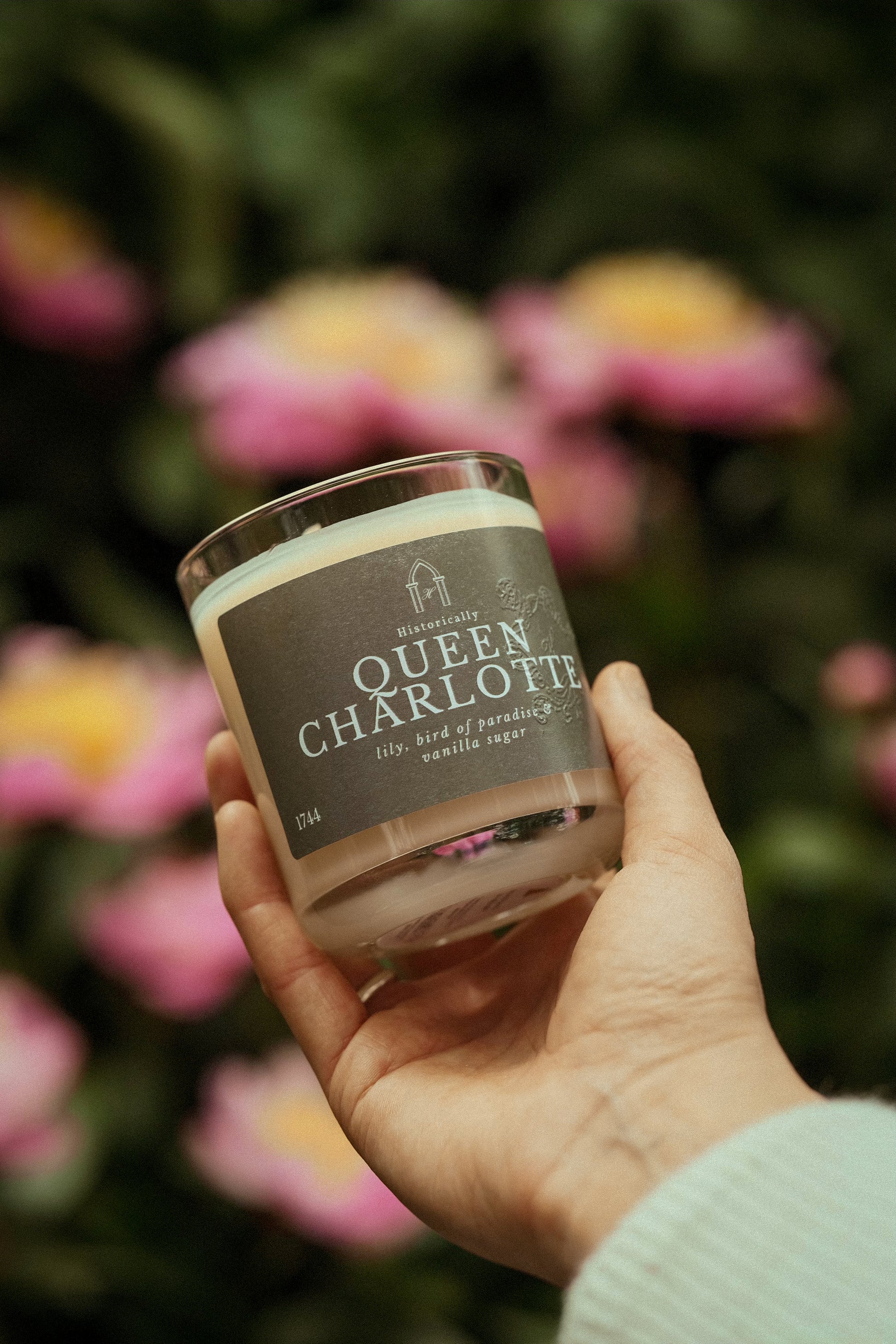
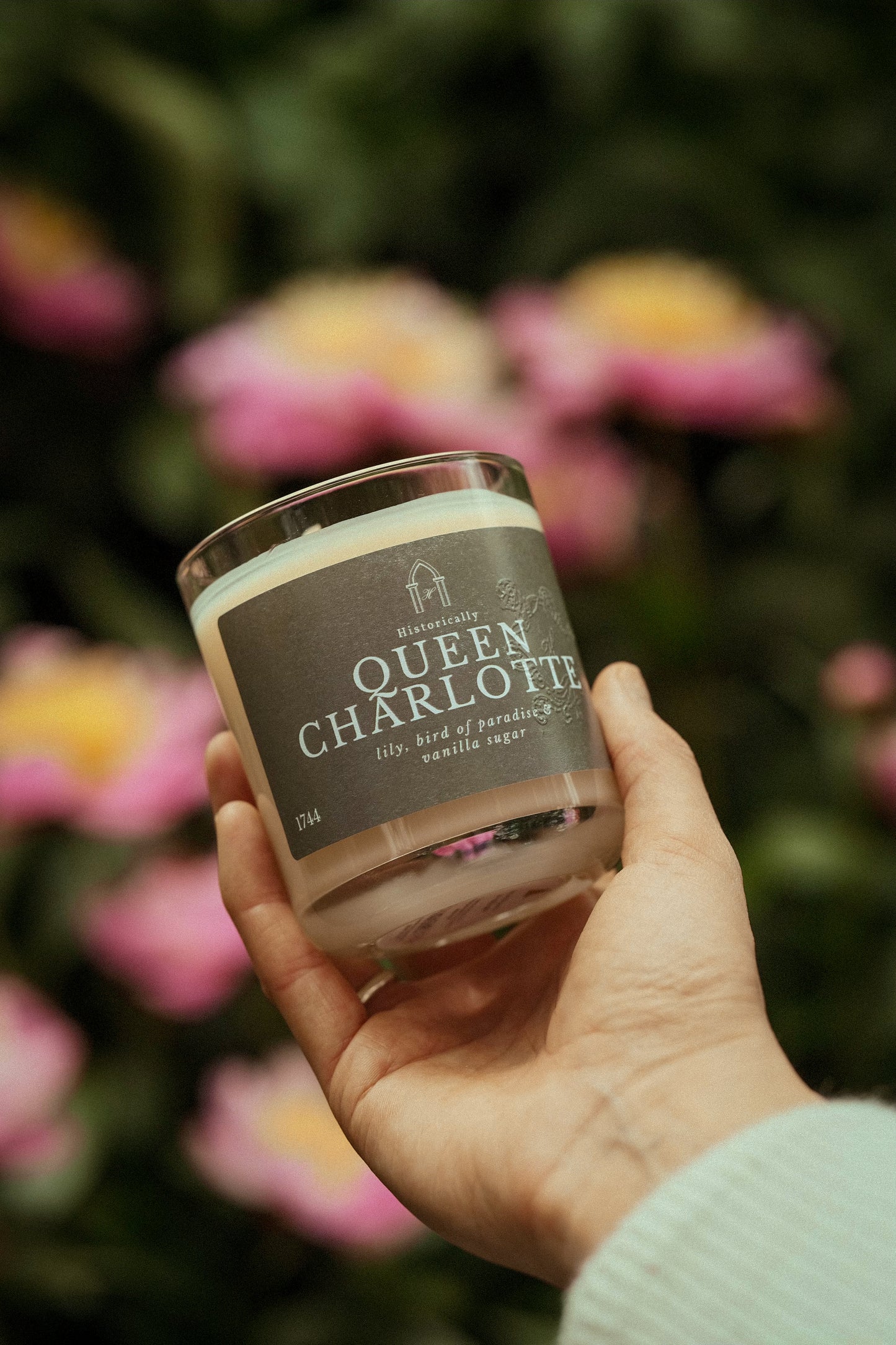
Queen Charlotte
Queen Charlotte
Couldn't load pickup availability
Queen Charlotte and regency florals.
A regal tribute to the botanical passions of Queen Charlotte of Mecklenburg-Strelitz. The majestic Bird of Paradise, named 'Strelitzia Reginae' in her honour, blossoms alongside the serene purity of lilies. This exquisite blend captures the essence of her royal Kew Gardens, with a whisper of vanilla sugar to sweeten the air, evoking a stately and aromatic homage to a Queen's refined and botanical love.
170g/400g
Up to 40/100 hours of burn time
Recyclable glass vessel
100% Sustainable and natural soy wax
High quality fragrance oil free from parabens and phalphates
Vegan and free from animal cruelty
Made in the UK
Share
Scent Inspiration
Scent Inspiration
The bird of paradise flower creates the base of this scent, inspired by the plant that was named in her honour, with notes of fresh florals taking through the Queen's favourite gardens at Kew before settling into vanilla sugar, a nod to Charlotte's sweet tooth.
History behind the Woman
History behind the Woman
Charlotte of Mecklenburg Strelitz, known to Britain simply as Queen Charlotte, her life was one of quiet influence, intellectual curiosity, and steadfast duty. As the wife of George III, Charlotte became one of the longest serving consorts in British history and helped shape the cultural life of the Georgian court.
Charlotte was born in 1744 in the small German duchy of Mecklenburg Strelitz, a modest principality within the complex patchwork of states that made up the Holy Roman Empire. Her father, Charles Louis Frederick, Duke of Mecklenburg Strelitz, ruled a relatively minor territory, and Charlotte’s upbringing reflected the quiet provincial life of a German court rather than the grandeur of Europe’s great capitals.
Her education, however, was thoughtful and disciplined. Like many young noblewomen of the eighteenth century, Charlotte was instructed in languages, music, religion, and domestic management. She developed a particular love of music and botany, interests that would later flourish during her years as queen. Contemporary accounts describe her as intelligent, diligent, and reserved, with a strong sense of duty and moral character.
In 1761 her life changed abruptly. Following the death of his grandfather George II, the young king George III had ascended the British throne. Advisors began searching for a suitable Protestant bride who could strengthen diplomatic alliances and bring stability to the monarchy. Charlotte of Mecklenburg Strelitz was chosen.
The marriage negotiations moved with remarkable speed. Charlotte had never met the king when arrangements were finalised, and within weeks she was travelling across Europe to her new home. She arrived in England in September 1761 and married George III the very same evening at the Chapel Royal in St James’s Palace.
Their union marked the beginning of a partnership that would last nearly sixty years. Unlike many royal marriages of the era, the relationship between George and Charlotte appears to have been one of genuine affection and companionship. The king was known for his devotion to family life, and Charlotte became an essential presence in the domestic stability he sought to cultivate around the royal household.
Together they would have fifteen children, an extraordinary number even by royal standards. Among them were future monarchs George IV and William IV, as well as numerous princes and princesses whose marriages connected the British royal family with courts across Europe.
Charlotte’s influence extended beyond her role as mother and consort. She became a central figure in the cultural life of the Georgian court, particularly through her patronage of music and the arts. One of the most fascinating chapters of her patronage involved her support for the young composer Wolfgang Amadeus Mozart. When Mozart visited London as a child prodigy in 1764, he performed before the royal family and later dedicated several of his compositions to the queen.
Music remained a defining feature of court life under Charlotte’s influence. Concerts, performances, and musical evenings became regular events within royal residences. Through her patronage she helped cultivate an environment where artistic talent could flourish.
Another passion that shaped Charlotte’s legacy was her deep interest in botany and horticulture. During the eighteenth century the study of plants was undergoing significant development as explorers and scientists catalogued species from across the globe. Charlotte embraced this intellectual curiosity and supported botanical study within Britain.
Her enthusiasm was particularly visible at Kew Gardens, which developed into an important centre for botanical research during her lifetime. The gardens became a place where rare plants were cultivated and studied, reflecting the queen’s fascination with the natural world.
Because of her dedication to botanical pursuits, Charlotte was sometimes affectionately called the Queen of Botany. Under her encouragement, the gardens at Kew expanded and evolved into one of the most significant botanical institutions in the world.
Yet Charlotte’s life was not defined solely by cultural pursuits and royal ceremony. As the years passed, the royal household faced increasing strain due to the deteriorating health of George III. The king suffered from recurring episodes of mental illness that periodically rendered him unable to rule.
These periods placed enormous responsibility upon the queen. Charlotte became both caretaker and protector of the king, often managing delicate family and political situations while maintaining the dignity of the monarchy. Her role during these difficult years revealed a resilience and loyalty that earned her respect among contemporaries.
In 1788 and again in later years, the king’s illness became severe enough to provoke national concern. Debates arose within Parliament about how the country should be governed if the king remained incapacitated. Charlotte found herself navigating both personal anguish and political scrutiny as the crisis unfolded.
Despite these challenges she remained devoted to her husband. The later years of their marriage were marked by physical separation as the king’s condition worsened, yet Charlotte continued to safeguard his reputation and legacy.
She died in 1818 at the age of seventy four, only a year before George III himself passed away. Their marriage had endured through decades of political change, war, and personal hardship.
Scent Notes
Scent Notes
lily, orchid, watery jasmine, iris, violet, rose, spice, woods, patchouli, amber, musk and vanilla sugar.
Safety Information
Safety Information
Contains Benzyl salicylate, Linalool, alpha-Hexylcinnamaldehyde. May produce an
allergic reaction.
Frequently Asked Questions
Candle Care
I. Keep candles away from curtains, fabrics, furniture, and draughts.
II. Avoid placing candles under shelves; maintain a 3-foot (1-meter) clearance above.
III. Prevent contact with clothes and hair; place candles out of reach.
IV. Keep children and pets at a distance from candles.
V. Maintain at least 4 inches (10cm) between burning candles.
VI. Extinguish before moving; avoid objects falling into hot wax.
VII. Never leave burning candles unattended.
VIII. Safely extinguish with a snuffer or spoon, not by blowing.
IX. Double-check to ensure candles are completely out.
Delivery & Returns
Dispatch times
Our candles are made to order and most will take between 3-5 business days to dispatch but this can extend up to 7 business days during busy periods.
However, if you are wanting your order sooner or for a specific date please get in touch and we can sort something out for you!
Delivery Times
We currently offer standard delivery with Royal Mail Tracked 48 which should arrive between 2-3 days after dispatch and express delivery with Royal Mail Tracked 24 which should arrive between 1-2 days after dispatch.
Shipping outside the UK
We are unable to ship to the EU and USA at this time.
Please do get in contact with us if you would like an order delivered outside of the UK and we will let you know if this is possible and what shipping charges will be. If it is possible we will calculate the shipping costs for you and complete your order via invoice.
Please note that customers are responsible for paying any import VAT, taxes and fees.
What is your return policy?
Please note earrings cannot be returned and refunded for hygiene reasons.
We are happy to accept returns if you are unhappy with your purchase.
Contact us within 14 days of delivery
Dispatch items back within 30 days of delivery
Request a cancellation within 24 hours of purchase (this is only possible if you haven't recieved a dispatch email)
Buyers are responsible for return postage costs. If the item is not returned in its original condition, the buyer is responsible for any loss in value.
Item damaged in transit
Sometimes accidents happen.
If you receive a parcel that has been damaged in the post please send a picture to us showing the damage within 48 hours of your parcel being delivered and we can discuss options with you.
- 5 stars: 7 (100%)
- 4 stars: 0 (0%)
- 3 stars: 0 (0%)
- 2 stars: 0 (0%)
- 1 star: 0 (0%)
This candle is so beautiful! The quality and delivery is always immaculate so can't recommend enough. Also, the advent calendars are the best, I've been ordering them every year!
This is a lovely fragrance. I would not normally go for floral scents but I have been surprised before with some of Liz’s creations. And again, this is one of them. Such a pity it’s limited edition. Highly recommend if you get the chance.
This is a lovely fragrance. I would not normally go for floral scents but I have been surprised before with some of Liz’s creations. And again, this is one of them. Such a pity it’s limited edition. Highly recommend if you get the chance.
This is a lovely fragrance. I would not normally go for floral scents but I have been surprised before with some of Liz’s creations. And again, this is one of them. Such a pity it’s limited edition. Highly recommend if you get the chance.
I bought this at Hampton Court Palace and it is my new favourite candle! Now that it's limited edition I think I might have to buy another one to get me through the summer!
I bought this at Hampton Court Palace and it is my new favourite candle! Now that it's limited edition I think I might have to buy another one to get me through the summer!
I bought this at Hampton Court Palace and it is my new favourite candle! Now that it's limited edition I think I might have to buy another one to get me through the summer!