

Historically
Neolithic Solstice
Neolithic Solstice
Couldn't load pickup availability
Neolithic Summer Solstice at Stonehenge.
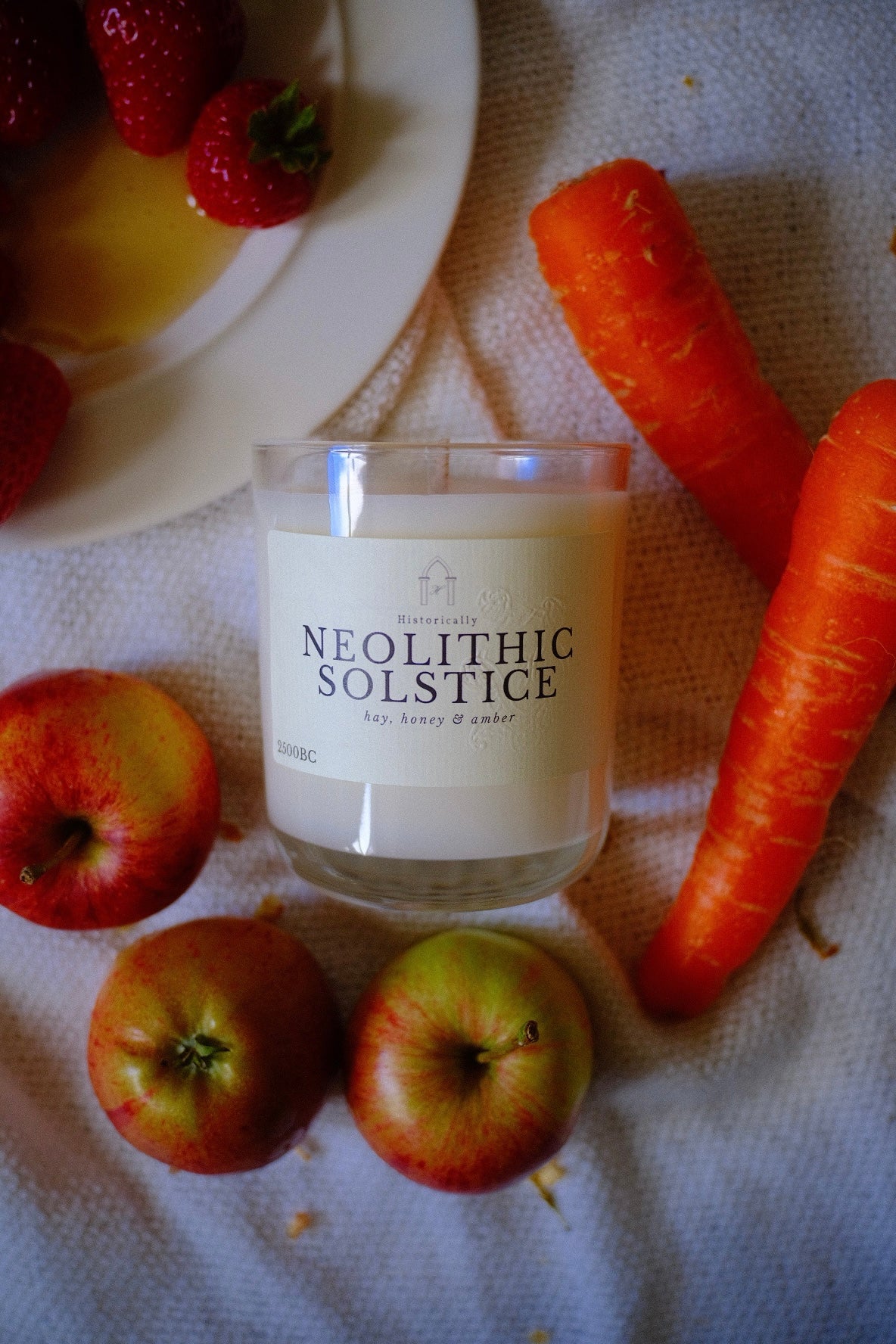
As ancient stones align with celestial wonders, the longest day awakens. The deep sweetness of honey melds with the warm embrace of amber and bright tones of hay echoing exuberent spirits and rituals in anticipation of the year’s harvest.
170g/400g
Up to 40/100 hours of burn time
Recyclable glass vessel
100% Sustainable and natural soy wax
High quality fragrance oil free from parabens and phalphates
Vegan and free from animal cruelty
Made in the UK
Share
Scent Inspiration
Scent Inspiration
For this scent we have chosen almost a summer version of our Neolithic Midwwinter scent. Here you'll still find warming amber and honey, reminicsent of the honey mead they would have drunk in celebration but with the addition of summer floral notes and fresh hay to represent that this solstice celebration was in hope of a bountiful harvest.
History behind the Woman
History behind the Woman
Few moments in the ancient calendar carried as much significance as the summer solstice. Long before written records, organised religion, or great cities, communities across Britain marked the longest day of the year with ceremonies, gatherings, and monumental architecture. During the Neolithic period, a time that stretched from around 4000 BCE to 2500 BCE, people lived in a world deeply connected to the rhythms of nature. The movement of the sun, moon, and stars was not simply observed but woven into everyday life, shaping agriculture, belief, and community identity.
For Neolithic people, the summer solstice represented far more than an astronomical event. It marked the height of the sun's power, the peak of the growing season, and a moment when the natural and spiritual worlds may have felt especially close. Though the beliefs of these communities remain largely beyond our reach, the monuments they left behind suggest that the summer solstice occupied a place of profound importance within their understanding of the world.
The Neolithic period transformed Britain. Communities that had once lived primarily through hunting and gathering increasingly adopted farming. Permanent settlements emerged, forests were cleared, and people began to cultivate crops and raise livestock. This shift fundamentally altered the relationship between humans and the landscape.
Success depended upon understanding seasonal cycles. Knowing when to sow crops, when to harvest, and how to prepare for the changing seasons became essential. The sun, whose movement governed the passing of the year, naturally assumed a central role within this new agricultural world.
Across Britain, evidence survives of remarkable monuments carefully aligned with the rising or setting sun at key points in the year. These structures reveal an extraordinary awareness of celestial movements and suggest that observing the heavens was an important part of Neolithic life.
The most famous of these monuments is undoubtedly Stonehenge. Situated on Salisbury Plain, Stonehenge continues to attract visitors from around the world, particularly during the summer solstice. Although the monument was constructed over many centuries, its alignment with the solstice sunrise remains one of its most striking features.
On the morning of the summer solstice, the rising sun appears directly above the Heel Stone when viewed from the centre of the monument. The effect is dramatic even today and would likely have been even more powerful in the Neolithic landscape, before modern development altered the surrounding environment.
Stonehenge was not unique. Across Britain and Ireland, monuments such as passage tombs, cursus monuments, timber circles, and stone circles demonstrate similar concern with celestial events. These alignments suggest that Neolithic communities possessed sophisticated observational knowledge and invested considerable effort in marking significant moments within the solar year.
The construction of such monuments required extraordinary organisation. Massive stones were transported across great distances, earthworks were excavated using simple tools, and complex structures were planned with remarkable precision. These projects brought communities together and may have served as focal points for seasonal gatherings.
Archaeological evidence increasingly suggests that sites like Stonehenge were not isolated places of worship but centres of social activity. People travelled considerable distances to visit them, bringing livestock, pottery, and other goods. Excavations have revealed evidence of large scale feasting, suggesting that important ceremonies were accompanied by communal celebrations.
The summer solstice may have provided one of the key occasions for these gatherings. At a time when daylight stretched far into the evening and the landscape was abundant with life, communities could come together to reinforce social bonds, exchange goods, arrange marriages, and participate in shared rituals.
While we cannot know precisely what Neolithic people believed, many archaeologists suggest that the solstice may have symbolised renewal, fertility, abundance, or the cyclical nature of existence. The sun's journey across the sky provided a visible reminder that life moved in recurring patterns, from growth to harvest, from darkness to light.
The connection between the summer solstice and fertility is particularly compelling. By late June crops were growing strongly in the fields, livestock were thriving, and the promise of the coming harvest was becoming increasingly visible. Celebrating the height of the sun's strength may have been a way of acknowledging and encouraging the forces that sustained life.
The Neolithic world was one in which the boundaries between the practical and the spiritual were likely less distinct than they are today. Observing the heavens was not merely a scientific exercise. It was part of a broader understanding of humanity's place within the landscape and the cosmos.
Many of the monuments associated with solstice alignments also appear connected to ideas of ancestry and memory. Tombs, ceremonial avenues, and gathering places suggest that the living maintained relationships with those who had gone before them. Seasonal ceremonies may therefore have honoured both the cycles of nature and the continuity of community across generations.
What makes the Neolithic summer solstice particularly fascinating is the sense of continuity it creates. Thousands of years separate modern observers from the people who first built these monuments, yet the same sun still rises above the same horizon. The alignment remains unchanged, linking present and past through a shared experience of light and landscape.
Every year, visitors gather at Stonehenge to watch the solstice sunrise, participating in a tradition that echoes practices stretching back millennia. Although our beliefs and societies have changed dramatically, the sense of wonder inspired by the event remains remarkably familiar.
The summer solstice reminds us that long before written history, people were observing the skies, tracking the seasons, and seeking meaning within the natural world. Their monuments stand as enduring evidence of curiosity, ingenuity, and a profound connection to the rhythms of the earth.
In the story of Neolithic Britain, the summer solstice represents more than a single day. It symbolises humanity's enduring desire to understand the forces that shape our lives and to mark the moments when the ordinary world seems touched by something greater.
Thousands of years after the first stones were raised and the first ceremonies held, the longest day of the year continues to inspire reflection, celebration, and awe. The sun that illuminated the fields and monuments of Neolithic Britain still rises each summer, carrying with it the echoes of one of humanity's oldest traditions.
Scent Notes
Scent Notes
bergamot, honey blossom, jasmine, lavender, nutmeg, rose, spice, mint, patchouli, sandalwood, cedarwood, vanilla, & musk
Honey:
The history of honey stretches back to the dawn of humanity, when prehistoric foragers risked stings and swarms to extract the liquid gold secreted by bees. In ancient times, honey was not merely a sweet treat but a vital source of sustenance, offering quick energy and long shelf life for early humans on the move. Its medicinal properties were revered, used to treat wounds and soothe respiratory ailments. Honey's significance extended to religious rituals, symbolizing sweetness in ceremonies. The evolution of beekeeping led to more efficient honey production. Today, honey remains beloved for its flavor and diverse uses, from sweetening tea to enhancing culinary delights. Its rich history showcases the enduring appeal of this golden gift from nature.
Amber:
Amber, the fossilized resin of ancient trees, has a history spanning millions of years, dating back to the Eocene epoch. It was treasured in antiquity for its beauty and believed healing properties by the Greeks and Romans. During the Middle Ages, it was a luxury item, adorning objects like the famous Amber Room in Russia. In modern times, amber has unveiled ancient life forms, aiding our understanding of Earth's past. Today, it retains its value for its beauty, history, and scientific insights into ancient ecosystems.
Safety Information
Safety Information
Contains Acetyl cedrene, Coumarin, Linalool, Linalyl acetate. May produce an allergic reaction.
Frequently Asked Questions
Candle Care
I. Keep candles away from curtains, fabrics, furniture, and draughts.
II. Avoid placing candles under shelves; maintain a 3-foot (1-meter) clearance above.
III. Prevent contact with clothes and hair; place candles out of reach.
IV. Keep children and pets at a distance from candles.
V. Maintain at least 4 inches (10cm) between burning candles.
VI. Extinguish before moving; avoid objects falling into hot wax.
VII. Never leave burning candles unattended.
VIII. Safely extinguish with a snuffer or spoon, not by blowing.
IX. Double-check to ensure candles are completely out.
Delivery & Returns
Dispatch times
Our candles are made to order and most will take between 3-5 business days to dispatch but this can extend up to 7 business days during busy periods.
However, if you are wanting your order sooner or for a specific date please get in touch and we can sort something out for you!
Delivery Times
We currently offer standard delivery with Royal Mail Tracked 48 which should arrive between 2-3 days after dispatch and express delivery with Royal Mail Tracked 24 which should arrive between 1-2 days after dispatch.
Shipping outside the UK
We are unable to ship to the EU and USA at this time.
Please do get in contact with us if you would like an order delivered outside of the UK and we will let you know if this is possible and what shipping charges will be. If it is possible we will calculate the shipping costs for you and complete your order via invoice.
Please note that customers are responsible for paying any import VAT, taxes and fees.
What is your return policy?
Please note earrings cannot be returned and refunded for hygiene reasons.
We are happy to accept returns if you are unhappy with your purchase.
Contact us within 14 days of delivery
Dispatch items back within 30 days of delivery
Request a cancellation within 24 hours of purchase (this is only possible if you haven't recieved a dispatch email)
Buyers are responsible for return postage costs. If the item is not returned in its original condition, the buyer is responsible for any loss in value.
Item damaged in transit
Sometimes accidents happen.
If you receive a parcel that has been damaged in the post please send a picture to us showing the damage within 48 hours of your parcel being delivered and we can discuss options with you.