


Historically
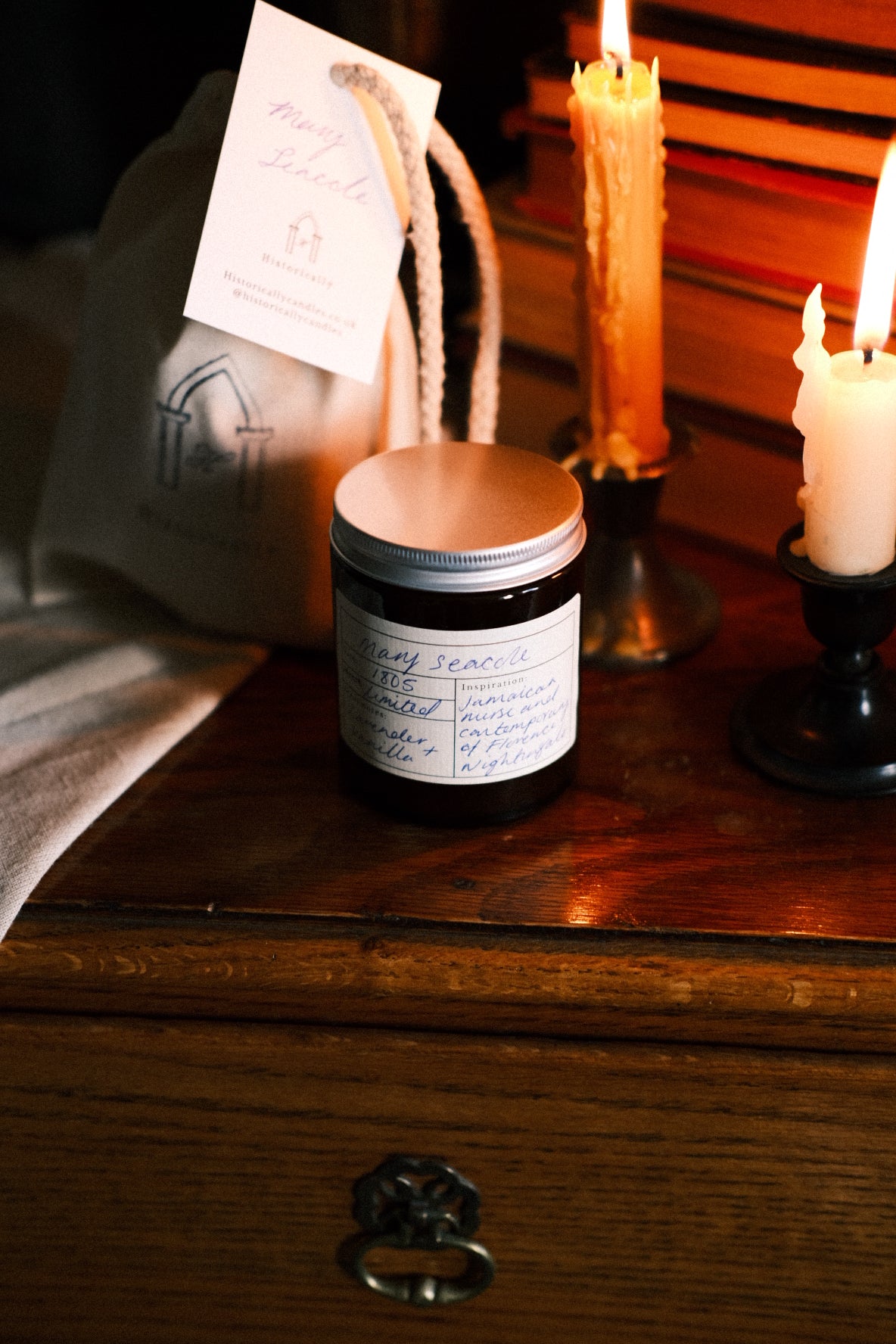
Mary Seacole | Limited Edition
Mary Seacole | Limited Edition
Couldn't load pickup availability
This is a Limited Edition scent for Mary Seacole, inspired by the recipes she used to heal wounded soldiers in Crimea. She is available in this scent for as long as stocks last.
Healer of the Crimea.
Inspired by Mary Seacole, a Jamaican nurse, businesswoman, and contemporary of Florence Nightingale, this candle honours her pioneering remedies. Soft lavender recalls the soothing treatments she used to calm and cleanse, while rich vanilla recalls the nourishing comforts she provided. A fragrance of care and courage, bringing a gentle, restorative glow to any space.
160g/400g
Up to 40/100 hours of burn time
Recyclable glass vessel
100% Sustainable and natural soy wax
High quality fragrance oil free from parabens and phalphates
Vegan and free from animal cruelty
Made in the UK
Share
Scent Inspiration
Scent Inspiration
History behind the Woman
History behind the Woman
Born Mary Jane Grant in Kingston, Jamaica, in 1805, she grew up in a society shaped by British colonial rule and slavery. Her father was a Scottish soldier, while her Jamaican mother, known as Mrs Grant, ran a boarding house called Blundell Hall and was respected for her knowledge of traditional medicine. From her mother, Mary learned about herbal remedies, nursing, and the treatment of illness, skills that would become central to her later life.
Mary showed an independent spirit from an early age. She travelled widely at a time when long distance journeys were unusual for women travelling alone, particularly women of mixed heritage. Her visits to Britain and travels throughout the Caribbean and Central America exposed her to different cultures, medical practices, and diseases. These experiences gave her practical knowledge that could rarely have been acquired through conventional education.
In 1836, Mary married Edwin Horatio Hamilton Seacole, but their marriage was relatively brief. Edwin died in 1844, and Mary also lost her mother around this period. Rather than retreat from public life, she continued to develop her own businesses and medical knowledge, establishing herself as an independent woman responsible for her own livelihood.
Her abilities were tested during outbreaks of cholera in Jamaica and Panama. Cholera was one of the nineteenth century's most feared diseases, spreading rapidly through communities where sanitation and clean water were inadequate. Mary treated sufferers and observed the disease closely. Some of the treatments available during her lifetime would now be considered ineffective or dangerous, but her willingness to nurse those affected demonstrated the practical experience and personal courage that characterised her career.
It was the outbreak of the Crimean War in 1853 that would bring Mary Seacole lasting recognition. Reports reaching Britain described appalling conditions faced by wounded and sick soldiers. Mary travelled to London and attempted to join the official nursing effort, but her offers were rejected. She later questioned whether racial prejudice had contributed to these refusals, although the precise reasons behind them remain uncertain.
Mary refused to allow rejection to determine what happened next. Instead, she financed her own journey to the Crimea with her business partner Thomas Day. Near Balaclava they established the British Hotel, an enterprise that provided food, supplies, meals, and accommodation for officers while helping to fund Mary's nursing activities.
The British Hotel demonstrated an important aspect of Mary Seacole's character that can sometimes be overshadowed by her nursing. She was an experienced businesswoman. Throughout her life, commerce provided her with both independence and the means to pursue her ambitions. In the Crimea, her entrepreneurial ability enabled her to create a place where soldiers could obtain familiar comforts amid the hardships of war.
Her work was not confined to the British Hotel. Mary travelled to areas close to the fighting, carrying food, medicines, and supplies. Soldiers affectionately called her Mother Seacole, and accounts of her presence near the battlefield helped establish her reputation in Britain. She offered practical assistance and comfort to men experiencing the brutal realities of nineteenth century warfare.
Mary's work differed from that of Florence Nightingale, although the two women are frequently compared. Nightingale worked within a more organised hospital system and became an influential reformer of nursing and public health. Seacole operated independently, combining nursing with entrepreneurship and providing assistance closer to the fighting. Their contributions are better understood within their different circumstances rather than as a competition between two remarkable women.
When the Crimean War ended in 1856, Mary returned to Britain in serious financial difficulty. The supplies purchased for the British Hotel had lost much of their value when the soldiers departed, leaving her facing bankruptcy. Yet the affection she had inspired during the war became apparent when military officers, soldiers, and members of the public supported fundraising efforts on her behalf.
In 1857, Mary published her autobiography, Wonderful Adventures of Mrs Seacole in Many Lands. It was an extraordinary achievement. Written in a lively and engaging voice, the book recorded her travels, business ventures, experiences of racism, and adventures during the Crimean War. It became one of the earliest autobiographies published in Britain by a Black woman and allowed Mary to present her life in her own words rather than leaving others to define her story.
Mary Seacole died in London in 1881. Her reputation gradually faded from popular memory before renewed historical interest during the twentieth and twenty first centuries brought her achievements to wider attention. Today, her life offers an important window into Victorian Britain and its empire, revealing a world in which race, gender, class, commerce, medicine, and colonialism were deeply interconnected.
Scent Notes
Scent Notes
Lavender & vanilla
Lavender:
Although lavender is native to the Mediterranean, it was the Romans who introduced lavender to Britain nearly 2,000 years ago, where it was valued for bathing, medicine, and fragrance. During the medieval period it was grown in monastery gardens for treating ailments and freshening linens. By the Tudor and Victorian eras, lavender had become a familiar feature of British gardens, while French lavender oil was especially prized for perfumes and soaps. Today, it remains one of Britain's most cherished garden plants and fragrance ingredients.
Vanilla:
Vanilla, native to Mexico and Central America, reached Europe in the 16th century with Spanish explorers but remained rare for centuries, prized by the British elite for its exotic aroma and use in sweet drinks and desserts. Queen Elizabeth I was among its early admirers, helping it gain prestige. In the 19th century, Edmond Albius’s discovery of hand-pollination on Réunion revolutionised production, allowing cultivation in colonial regions such as Madagascar and Mauritius, which expanded British access. By the Victorian era, vanilla had become a hallmark of refinement, flavouring custards, puddings, and ice creams in homes across Britain.
Safety Information
Safety Information
-


Frequently Asked Questions
Candle Care
I. Keep candles away from curtains, fabrics, furniture, and draughts.
II. Avoid placing candles under shelves; maintain a 3-foot (1-meter) clearance above.
III. Prevent contact with clothes and hair; place candles out of reach.
IV. Keep children and pets at a distance from candles.
V. Maintain at least 4 inches (10cm) between burning candles.
VI. Extinguish before moving; avoid objects falling into hot wax.
VII. Never leave burning candles unattended.
VIII. Safely extinguish with a snuffer or spoon, not by blowing.
IX. Double-check to ensure candles are completely out.
Delivery & Returns
Dispatch times
Our candles are made to order and most will take between 3-5 business days to dispatch but this can extend up to 7 business days during busy periods.
However, if you are wanting your order sooner or for a specific date please get in touch and we can sort something out for you!
Delivery Times
We currently offer standard delivery with Royal Mail Tracked 48 which should arrive between 2-3 days after dispatch and express delivery with Royal Mail Tracked 24 which should arrive between 1-2 days after dispatch.
Shipping outside the UK
We are unable to ship to the EU and USA at this time.
Please do get in contact with us if you would like an order delivered outside of the UK and we will let you know if this is possible and what shipping charges will be. If it is possible we will calculate the shipping costs for you and complete your order via invoice.
Please note that customers are responsible for paying any import VAT, taxes and fees.
What is your return policy?
Please note earrings cannot be returned and refunded for hygiene reasons.
We are happy to accept returns if you are unhappy with your purchase.
Contact us within 14 days of delivery
Dispatch items back within 30 days of delivery
Request a cancellation within 24 hours of purchase (this is only possible if you haven't recieved a dispatch email)
Buyers are responsible for return postage costs. If the item is not returned in its original condition, the buyer is responsible for any loss in value.
Item damaged in transit
Sometimes accidents happen.
If you receive a parcel that has been damaged in the post please send a picture to us showing the damage within 48 hours of your parcel being delivered and we can discuss options with you.