


Historically
Mary Queen of Scots
Mary Queen of Scots
Couldn't load pickup availability
Pomander of the Queen.
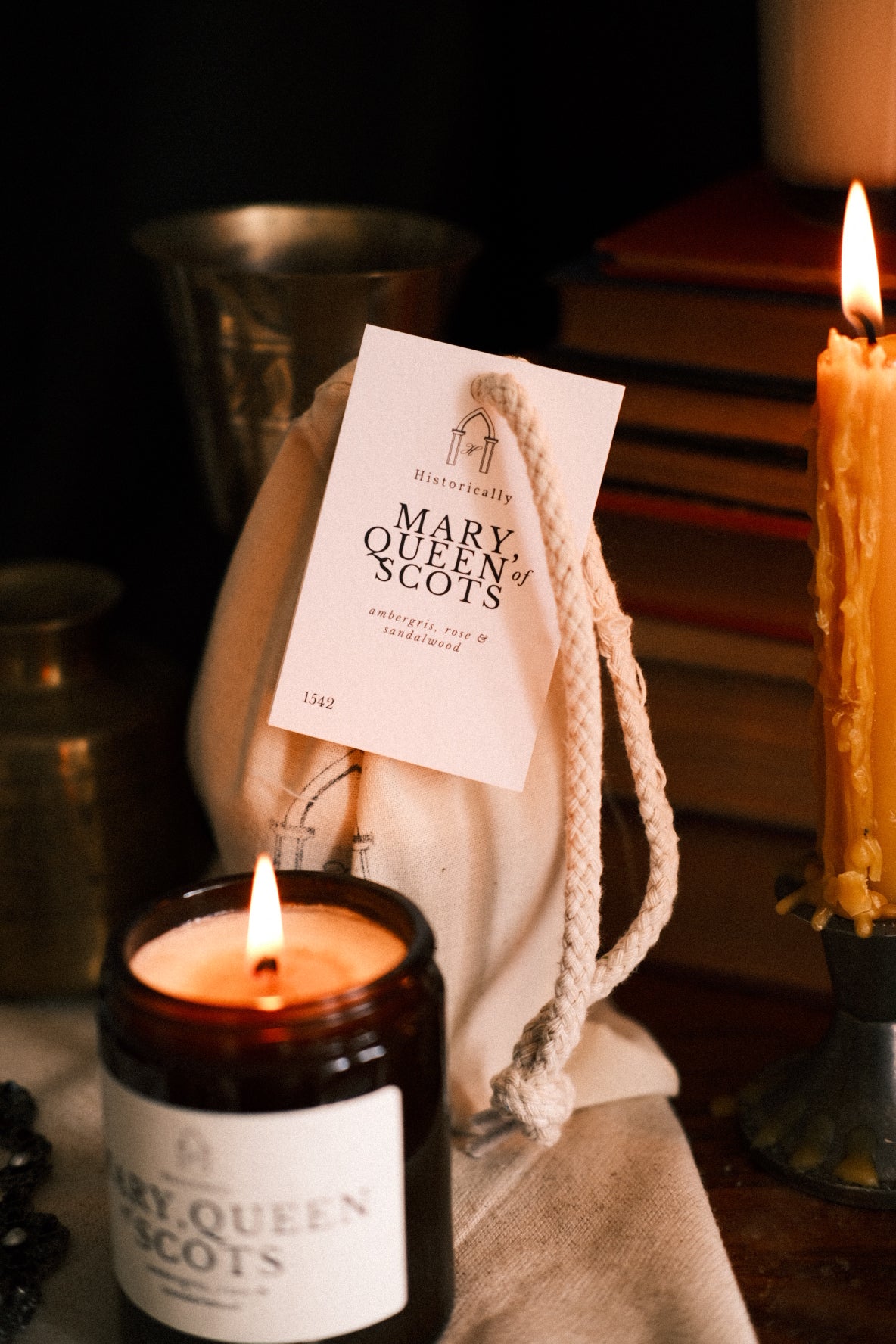
Inspired by the pomander beads believed to have belonged to Mary, Queen of Scots, this candle evokes the wild soul of Scotland and the lingering elegance of its most tragic queen. Ambergris rises like whispered prayers, entwined with tender rose and the sacred warmth of sandalwood. A scent of devotion and defiance, echoing faith, power and the enduring spirit of a Scottish monarch.
160g/400g
Up to 40/100 hours of burn time
Recyclable glass vessel and aluminium lid
100% Sustainable and natural soy wax
High quality fragrance oil free from parabens and phalphates
Vegan and free from animal cruelty
Made in the UK
Share
Scent Inspiration
Scent Inspiration
Inspired by traces found in pomander beads believed to have been hers, it is one of the most accurate Tudor scents we have to date.
History behind the Woman
History behind the Woman
Born in 1542 at Linlithgow Palace, Mary became Queen of Scotland when she was only six days old following the death of her father, James V of Scotland. Too young to rule, Scotland was governed by regents while the infant queen became the centre of political negotiations between Scotland, England, and France. To protect her from English ambitions, Mary was sent to the French court, where she received an education that reflected the finest traditions of Renaissance Europe. Fluent in several languages and accomplished in music, dancing, poetry, and diplomacy, she grew into one of the most cultured royal women of her generation.
In 1558, Mary married the future Francis II of France, briefly becoming Queen of France as well as Queen of Scotland. For a moment, her future appeared exceptionally bright. Yet within two years Francis had died, leaving the young widow to return to a Scotland transformed by the Protestant Reformation. The Catholic kingdom she had left as a child had become deeply divided, and Mary faced the immense challenge of ruling a nation whose religious and political landscape had changed beyond recognition.
Although a committed Catholic, Mary initially sought compromise, allowing Protestantism to remain established while privately practising her own faith. Her court became renowned for its elegance, learning, and artistic refinement, reflecting the influence of the French Renaissance she had embraced during her years abroad. Yet beneath this cultured exterior, powerful Scottish nobles competed relentlessly for influence, and Mary's authority was constantly tested by factions determined to shape the future of the kingdom.
Her personal life proved equally turbulent. Her marriage to Henry Stuart, Lord Darnley quickly deteriorated into bitterness and distrust. Darnley's jealousy, political ambition, and volatile temperament created instability at court, culminating in the brutal murder of Mary's secretary, David Rizzio, within the walls of Holyrood Palace. Only months later, Mary gave birth to her only child, the future James VI and I, whose eventual inheritance of both the Scottish and English crowns would unite the kingdoms under a single monarch.
The mysterious death of Lord Darnley in 1567 marked a turning point in Mary's reign. Found dead after an explosion at Kirk o' Field, the circumstances surrounding his death have remained the subject of debate for centuries. Suspicion quickly fell upon James Hepburn, Earl of Bothwell, whom Mary controversially married only weeks later. Whether she acted willingly, under pressure, or as part of a wider political calculation continues to divide historians, but the consequences were immediate. Her marriage alienated many of her supporters, rebellion spread across Scotland, and Mary was forced to abdicate in favour of her infant son.
Hoping to find protection, Mary fled south into England, seeking the support of her cousin, Elizabeth I. Instead of sanctuary, she found imprisonment. For nearly nineteen years Mary lived under varying degrees of confinement, becoming the focus of Catholic hopes and Protestant fears. Her royal blood and legitimate claim to the English throne made her a continual source of anxiety for Elizabeth's government, particularly as England faced growing religious tensions and threats from Catholic Europe.
Over the years, Mary's name became associated with a series of conspiracies against Elizabeth. Whether she actively encouraged every plot remains a matter of historical debate, but in 1586 she was implicated in the Babington Plot, a scheme that proposed Elizabeth's assassination and Mary's accession to the English throne. The evidence presented at her trial was considered sufficient by Elizabeth's ministers, and Mary was convicted of treason.
On 8 February 1587, Mary was executed at Fotheringhay Castle. Dressed in black with a crimson gown beneath, the traditional colour of Catholic martyrdom, she met her death with remarkable composure. Her execution shocked courts across Europe and transformed her into a powerful symbol for many Catholics. Ironically, the woman Elizabeth believed necessary to remove would ultimately achieve through her son what diplomacy and conflict had failed to accomplish. In 1603, James VI of Scotland inherited the English crown as James I, uniting the crowns of England and Scotland and beginning a new chapter in British history.
Scent Notes
Scent Notes
ambergris, rose & sandalwood
Ambergris:
Ambergris is a rare substance produced by sperm whales and occasionally washed ashore after floating at sea for many years. Highly valued from the Middle Ages onwards, it was traded throughout Europe and the Middle East as one of the finest perfume ingredients because of its remarkable ability to preserve fragrance. Britain's extensive coastline meant that occasional discoveries of ambergris were made on its shores, although ownership traditionally belonged to the Crown. During the Georgian and Victorian periods, ambergris became a luxury ingredient in British perfumery and was also used to scent gloves, cosmetics, and even confectionery for the wealthy.
Rose:
Roses have been cultivated for over 5,000 years, first in Asia before spreading throughout Europe and the Middle East. The Romans introduced cultivated roses to Britain, where they were grown for beauty, perfume, medicine, and religious ceremonies. During the medieval period, roses flourished in monastery gardens and became symbols of devotion and healing. The Tudor dynasty strengthened the flower's importance through the Tudor Rose, while the Victorians embraced roses for ornamental gardens and perfume production. Today, roses remain one of Britain's most iconic flowers, celebrated in gardens, fragrances, cosmetics, and traditional rose water.
Sandalwood:
Sandalwood, particularly Indian sandalwood (Santalum album), has been treasured for over 3,000 years. In India it has long played an important role in religious ceremonies, Ayurvedic medicine, and perfumery, while its fragrant wood was carved into decorative objects and temples. Sandalwood reached Britain through expanding trade with Asia and became increasingly popular during the Georgian and Victorian periods. British perfumers valued its warm, creamy aroma as a base note, while furniture makers admired its beautifully scented timber. Today, sandalwood remains an important ingredient in British luxury fragrances and home scent collections.
Safety Information
Safety Information
Contains 1-(1,2,3,4,5,6,7,8- Octahydro-2,3,8,8-tetramethyl-2-naphthalenyl)ethanone, Geraniol, Hydroxycitronellal, Linalool, alpha-Hexylcinnamaldehyde, alpha-isoMethylionone, d-Limonene, dl-Citronellol. May produce an allergic reaction.


Frequently Asked Questions
Candle Care
I. Keep candles away from curtains, fabrics, furniture, and draughts.
II. Avoid placing candles under shelves; maintain a 3-foot (1-meter) clearance above.
III. Prevent contact with clothes and hair; place candles out of reach.
IV. Keep children and pets at a distance from candles.
V. Maintain at least 4 inches (10cm) between burning candles.
VI. Extinguish before moving; avoid objects falling into hot wax.
VII. Never leave burning candles unattended.
VIII. Safely extinguish with a snuffer or spoon, not by blowing.
IX. Double-check to ensure candles are completely out.
Delivery & Returns
Dispatch times
Our candles are made to order and most will take between 3-5 business days to dispatch but this can extend up to 7 business days during busy periods.
However, if you are wanting your order sooner or for a specific date please get in touch and we can sort something out for you!
Delivery Times
We currently offer standard delivery with Royal Mail Tracked 48 which should arrive between 2-3 days after dispatch and express delivery with Royal Mail Tracked 24 which should arrive between 1-2 days after dispatch.
Shipping outside the UK
We are unable to ship to the EU and USA at this time.
Please do get in contact with us if you would like an order delivered outside of the UK and we will let you know if this is possible and what shipping charges will be. If it is possible we will calculate the shipping costs for you and complete your order via invoice.
Please note that customers are responsible for paying any import VAT, taxes and fees.
What is your return policy?
Please note earrings cannot be returned and refunded for hygiene reasons.
We are happy to accept returns if you are unhappy with your purchase.
Contact us within 14 days of delivery
Dispatch items back within 30 days of delivery
Request a cancellation within 24 hours of purchase (this is only possible if you haven't recieved a dispatch email)
Buyers are responsible for return postage costs. If the item is not returned in its original condition, the buyer is responsible for any loss in value.
Item damaged in transit
Sometimes accidents happen.
If you receive a parcel that has been damaged in the post please send a picture to us showing the damage within 48 hours of your parcel being delivered and we can discuss options with you.