


Historically
Eleanor of Aquitaine
Eleanor of Aquitaine
Couldn't load pickup availability
The Grandmother of Europe.
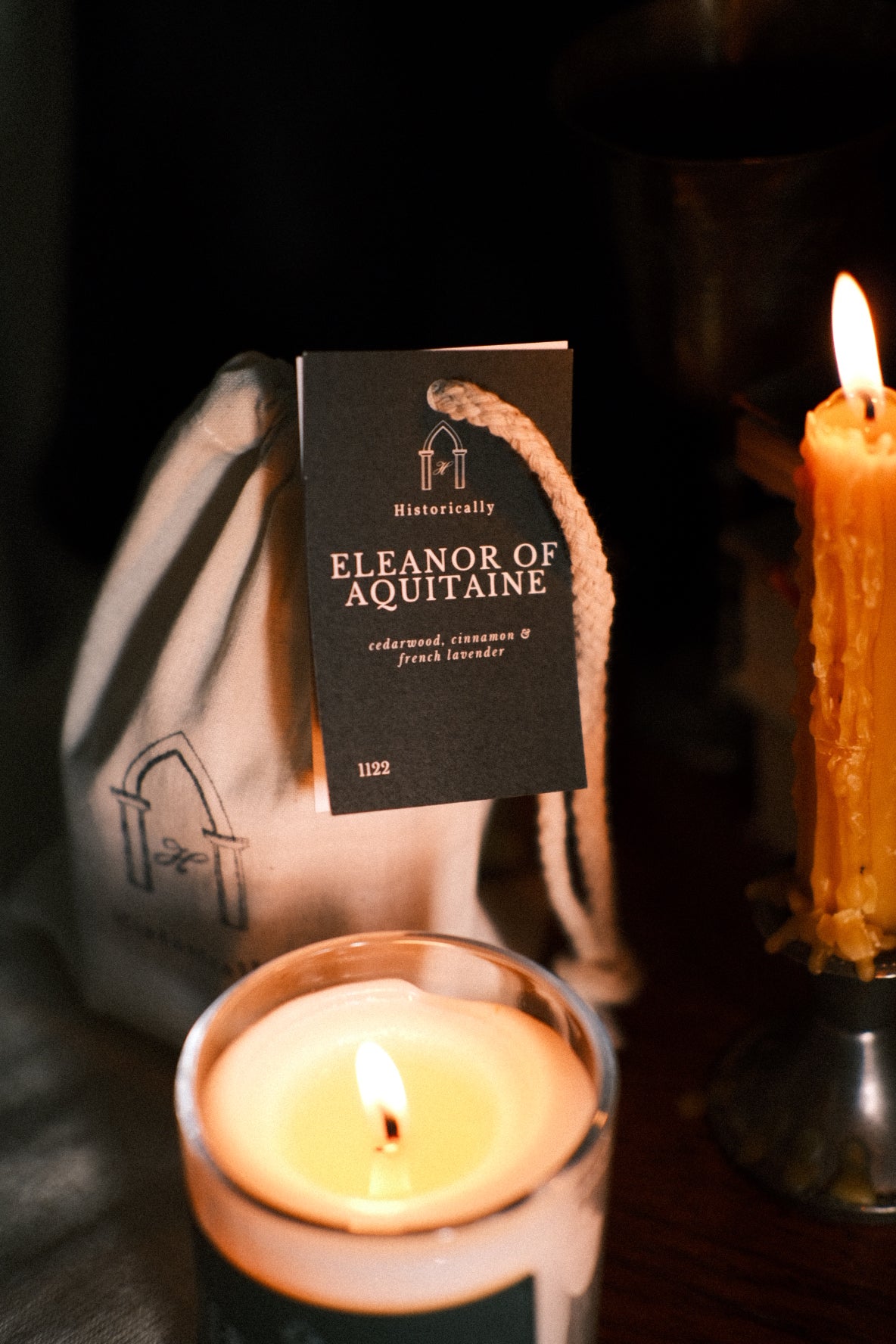
Queen of France and England, Eleanor of Aquitaine forged a dynasty whose children married into Europe’s royal houses. French lavender evokes her Aquitanian origins, while warm cinnamon recalls the tradition that credits her with helping introduce the spice to England. Grounding cedarwood brings strength and permanence. A regal fragrance of ambition, influence and medieval splendour, honouring a woman whose descendants reshaped the courts of Europe for generations.
170g/400g
Up to 40/100 hours of burn time
Recyclable glass vessel
100% Sustainable and natural soy wax
Essential oil blend
Vegan and free from animal cruelty
Made in the UK
Share
Scent Inspiration
Scent Inspiration
Inspired by french lavender fields and cinnamon that she is reportedly responsible for introducing to the UK.
History behind the Woman
History behind the Woman
Born around 1122 into the immensely wealthy Duchy of Aquitaine, Eleanor inherited one of the largest and most prosperous territories in western Europe while still in her teens. Aquitaine was renowned for its flourishing courts, sophisticated culture, and tradition of poetry and music. Unlike many noblewomen of her age, Eleanor was raised with an education befitting a ruler, learning the responsibilities of governance alongside an appreciation for literature, diplomacy, and the arts. As Duchess of Aquitaine in her own right, she possessed lands whose wealth rivalled that of many kings.
Her marriage to Louis VII of France in 1137 made her Queen of France, placing her at the centre of European politics. Yet the marriage proved an uneasy partnership. Eleanor's vibrant courtly upbringing contrasted sharply with Louis's deeply religious and reserved character, and tensions between the couple became increasingly apparent. Together they embarked upon the Second Crusade, an extraordinary undertaking that saw Eleanor travel thousands of miles across Europe and the eastern Mediterranean. Although the crusade ended in failure, her participation remains remarkable, reflecting both her determination and the exceptional role she occupied among medieval queens.
After fifteen years of marriage and the birth of two daughters, Eleanor's marriage to Louis was annulled in 1152. Within weeks, she married the energetic and ambitious Henry II of England, a union that transformed the political landscape of western Europe. Two years later Henry became King of England, and Eleanor once again found herself crowned queen, this time presiding over an empire that stretched from the Scottish borders to the Pyrenees.
As Queen of England, Eleanor was far more than a ceremonial figure. She travelled extensively throughout the Angevin Empire, governed her own territories, oversaw courts, managed estates, and acted as regent during Henry's absences. Her political experience and authority allowed her to play an active role in the administration of one of medieval Europe's largest realms. Together, Eleanor and Henry produced eight children, among them the future kings Richard I of England and John, King of England.
Yet Eleanor's life was far from peaceful. As Henry's relationships with their sons deteriorated, she found herself supporting the rebellion of her children against their father. The revolt failed, and Eleanor spent approximately sixteen years in varying degrees of captivity under Henry's orders. Even during imprisonment, however, her influence was never entirely extinguished. She remained a figure of immense political importance whose release awaited only the king's death.
When Henry II died in 1189, Eleanor immediately resumed an active role in government. Her son Richard I inherited the throne, but with much of his reign spent on crusade and in captivity, Eleanor effectively governed England and managed the Angevin territories in his absence. Well into her seventies, she travelled across Europe negotiating alliances, raising Richard's enormous ransom after his capture, and preserving the stability of the kingdom during one of its most uncertain periods.
Eleanor also left a lasting cultural legacy. Her courts at Poitiers and Aquitaine became closely associated with the flourishing traditions of troubadour poetry and courtly love, encouraging artistic expression that influenced medieval literature for generations. Whether every legend surrounding her patronage is entirely accurate remains debated, but there is little doubt that Eleanor fostered an environment where music, poetry, and intellectual life could thrive.
She spent her final years at Fontevraud Abbey, where she continued to advise her children and grandchildren before her death in 1204. Buried alongside Henry II and Richard the Lionheart, Eleanor left behind a dynasty that would dominate English and French history for centuries. Through her descendants, her influence extended across the royal houses of Europe, shaping the political landscape long after her own lifetime had ended.
Scent Notes
Scent Notes
cedarwood, cinnamon and french lavender
Cedarwood:
Cedarwood has been prized since ancient times, particularly in the Middle East, where the famous Cedars of Lebanon were used to build temples, palaces, and ships. The Egyptians also used cedarwood oil in embalming and religious ceremonies because of its preservative qualities and rich aroma. Although cedar trees are not native to Britain, cedarwood oil and timber were imported from the medieval period onwards. By the Georgian and Victorian eras, cedarwood was valued in Britain for fine furniture, chests, and wardrobes, where its natural insect repelling properties protected clothing and linens.
Cinnamon:
Cinnamon, derived from the bark of several Cinnamomum species native to Sri Lanka and southern India, has been traded for more than 4,000 years. It was highly valued by the ancient Egyptians, Greeks, and Romans for medicine, incense, and cooking. In Britain, cinnamon arrived through Roman trade but became particularly prized during the medieval period, when it was used in wealthy households to flavour meats, wines, and desserts. The spice became increasingly available through British trade with Asia and remains an essential ingredient in traditional British baking, mulled drinks, and festive recipes.
French Lavender:
Although lavender is native to the Mediterranean, it has been cultivated extensively in France for centuries, giving rise to the term "French lavender." The Romans introduced lavender to Britain nearly 2,000 years ago, where it was valued for bathing, medicine, and fragrance. During the medieval period it was grown in monastery gardens for treating ailments and freshening linens. By the Tudor and Victorian eras, lavender had become a familiar feature of British gardens, while French lavender oil was especially prized for perfumes and soaps. Today, it remains one of Britain's most cherished garden plants and fragrance ingredients.
Safety Information
Safety Information
Contains 1-Octen-3-yl acetate, Benzyl salicylate, Coumarin, Eucalyptol, Eugenol, Geraniol, Geranyl acetate, Isoeugenol, Neryl acetate, Terpinen-4-ol, a-Pinene, d-Limonene, lLimonene, trans-trans-Farnesol. May produce an allergic reaction.


Frequently Asked Questions
Candle Care
I. Keep candles away from curtains, fabrics, furniture, and draughts.
II. Avoid placing candles under shelves; maintain a 3-foot (1-meter) clearance above.
III. Prevent contact with clothes and hair; place candles out of reach.
IV. Keep children and pets at a distance from candles.
V. Maintain at least 4 inches (10cm) between burning candles.
VI. Extinguish before moving; avoid objects falling into hot wax.
VII. Never leave burning candles unattended.
VIII. Safely extinguish with a snuffer or spoon, not by blowing.
IX. Double-check to ensure candles are completely out.
Delivery & Returns
Dispatch times
Our candles are made to order and most will take between 3-5 business days to dispatch but this can extend up to 7 business days during busy periods.
However, if you are wanting your order sooner or for a specific date please get in touch and we can sort something out for you!
Delivery Times
We currently offer standard delivery with Royal Mail Tracked 48 which should arrive between 2-3 days after dispatch and express delivery with Royal Mail Tracked 24 which should arrive between 1-2 days after dispatch.
Shipping outside the UK
We are unable to ship to the EU and USA at this time.
Please do get in contact with us if you would like an order delivered outside of the UK and we will let you know if this is possible and what shipping charges will be. If it is possible we will calculate the shipping costs for you and complete your order via invoice.
Please note that customers are responsible for paying any import VAT, taxes and fees.
What is your return policy?
Please note earrings cannot be returned and refunded for hygiene reasons.
We are happy to accept returns if you are unhappy with your purchase.
Contact us within 14 days of delivery
Dispatch items back within 30 days of delivery
Request a cancellation within 24 hours of purchase (this is only possible if you haven't recieved a dispatch email)
Buyers are responsible for return postage costs. If the item is not returned in its original condition, the buyer is responsible for any loss in value.
Item damaged in transit
Sometimes accidents happen.
If you receive a parcel that has been damaged in the post please send a picture to us showing the damage within 48 hours of your parcel being delivered and we can discuss options with you.
- 5 stars: 1 (100%)
- 4 stars: 0 (0%)
- 3 stars: 0 (0%)
- 2 stars: 0 (0%)
- 1 star: 0 (0%)
Gorgeous candle and smells wonderful! Very evocative of Eleanor herself.