


Historically
Circe's Odyssey
Circe's Odyssey
Couldn't load pickup availability
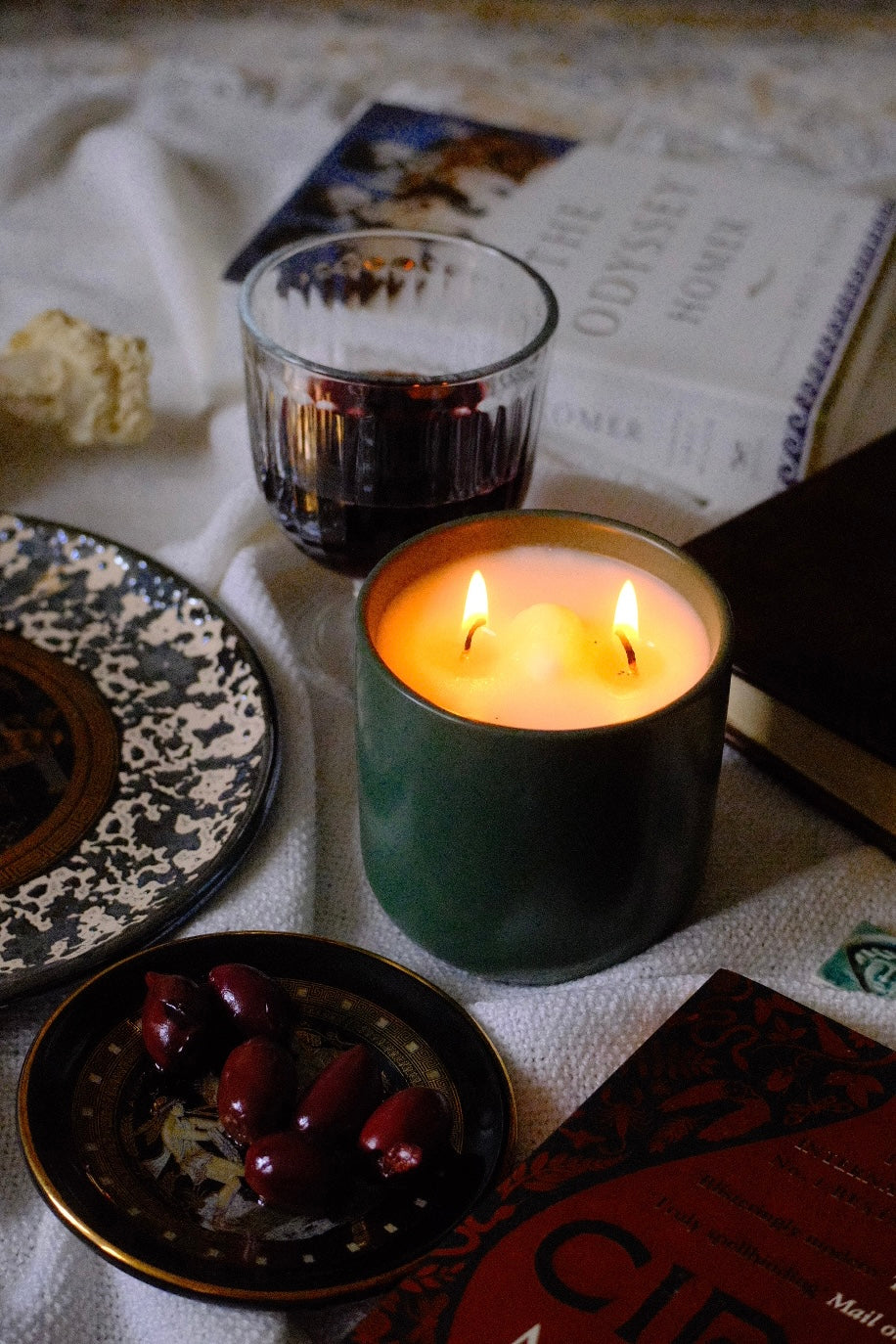
This is the final drop of the limited edition run to mark the anticipated release of the July 2026 film The Odyssey. Available in an exclusive ceramic vessel of dark green, this double wicked essential oil candle also features a female face gazing proudly from the candle.
Enchantress of Aeaea.
Inspired by Circe, daughter of Helios, this candle evokes the wild shores of Aeaea, an island some scholars place upon the pine clad coast of Italy. Maritime pine whispers of those ancient landscapes, while Greek geranium blooms with notes of healing, love, and fertility. Like the potions and enchanted wine of her legend, this fragrance weaves together beauty and mystery, casting a spell both alluring and untamed.
Usually we pride ourselves on featuring women and history from the UK only but for this extra special edition we have left the shores of the UK to visit the mythical lands of Ancient Greece.
300g
Up to 75 hours of burn time
Exclusive green ceramic vessel
100% Sustainable and natural soy wax
Essential oil blend
Vegan and free from animal cruelty
Made in the UK
Please note that due to impending heatwaves she may take longer to dispatch than usual. We expect this to be no longer than two weeks meaning you will have her in time for the Odyssey's theatrical release of the 17th of July.
Share
Scent Inspiration
Scent Inspiration
As a sorceress from myth it would have been easy to choose a sultry and mysterious scent to represent this often misunderstood female character. Instead we have taken inspiration from her island itself. Clearly a woman as skilled in potions and magic as Circe, the land around her would have been deeply important.
For this scent we have chosen maritime pine, extremely populous in Ancient Italy, to give not only the salty and woody scent of a coastal island but to suggest one of the Island's real world setting of Italy's coast near Rome. Other scholars however, place the island firmly in Greece but with views of Italy.
Beautiful geranium, which derives it's name from the ancient greek γέρανος (géranos), meaning crane, add a feminine touch. During the ancient period geranium was not only used in herbal remedies but it was symbolic of love and fertility. For the Odyssey geranium symbolises how Circe falls in love with Odysseus and the children they have together in some stories.
History behind the Woman
History behind the Woman
Few figures from classical mythology are as captivating or enduring as Circe. Part goddess, part sorceress, and wholly unforgettable, Circe occupies a unique place within the ancient world. Her story, immortalised in The Odyssey by Homer, has fascinated audiences for nearly three thousand years. She is neither villain nor heroine in the traditional sense. Instead, she exists in the space between, a powerful woman whose intelligence, independence, and command of magic challenged the expectations of both mortals and gods.
Unlike many female figures in Greek mythology whose stories revolve around marriage, motherhood, or tragedy, Circe is defined by her autonomy. She rules her own island, commands powerful magic, and answers to no husband or king. In a world filled with warriors and heroes, her strength comes not from weapons or armies but from knowledge, wisdom, and supernatural power.
According to ancient mythology, Circe was the daughter of Helios, the Titan god of the sun, and the Oceanid nymph Perse. This divine lineage placed her among some of the most powerful beings in Greek mythology. Yet despite her ancestry, Circe often exists apart from the grand dramas of Olympus. Her realm is not a heavenly palace but the remote and mysterious island of Aeaea.
Aeaea is described as a place of beauty and enchantment. Dense forests surround a magnificent hall where Circe lives among tame lions and wolves. These creatures, transformed through her magic, serve as a reminder of the extraordinary powers she possesses. To ancient audiences, the island represented both temptation and danger, a place where the normal rules of the world no longer applied.
Circe first appears in The Odyssey during the long journey home of the hero Odysseus. After years of war and hardship following the Trojan War, Odysseus and his men arrive on Aeaea seeking refuge and provisions.
The encounter quickly becomes one of the most memorable episodes in the epic. Circe welcomes a group of Odysseus's sailors into her hall and offers them food and drink. Yet hidden within the feast is a powerful enchantment. With a wave of her wand and a carefully prepared potion, she transforms the men into swine.
To modern readers the transformation often appears symbolic as much as literal. The sailors lose not only their human forms but also their dignity and self control. The episode reflects ancient concerns about temptation, excess, and the dangers of abandoning reason.
When Odysseus learns what has happened, he sets out to rescue his companions. Along the way he receives assistance from Hermes, the messenger god, who provides him with a magical herb known as moly. Protected from Circe's enchantments, Odysseus confronts the sorceress directly.
What follows is unusual within Greek mythology. Rather than defeating Circe through force, Odysseus meets her as an equal. Recognising that her magic has failed, Circe relents, restores his men to their human forms, and welcomes the travellers as honoured guests.
For a full year Odysseus and his crew remain on Aeaea. During this time Circe becomes not an adversary but an ally and guide. She offers wisdom, hospitality, and practical advice that ultimately helps Odysseus continue his journey home.
This transformation from threat to mentor is one reason Circe remains such a compelling figure. She embodies multiple roles simultaneously. She is dangerous yet generous, mysterious yet insightful, powerful yet capable of compassion. Ancient myths often divide women into simple categories of virtue or vice, but Circe resists such easy definitions.
Her mastery of magic is another key aspect of her enduring appeal. In Greek mythology, magic was often associated with secret knowledge, herbal remedies, and an understanding of forces beyond ordinary human perception. Circe's powers are rooted in learning and expertise rather than brute strength.
She represents a form of female authority that was both fascinating and unsettling to ancient audiences. Unlike queens whose power depended upon marriage or inheritance, Circe's influence comes entirely from her own abilities. She commands her island because of who she is and what she knows.
Over the centuries, writers, artists, and scholars have continually reinterpreted her story. Ancient authors expanded upon her mythology, while Renaissance painters portrayed her amid potions and enchanted beasts. More recently, modern writers have reimagined Circe as a complex protagonist whose experiences explore themes of identity, independence, and self determination.
These reinterpretations reflect changing attitudes toward powerful women. Where earlier generations often viewed Circe primarily as a dangerous temptress, contemporary audiences frequently see her as a figure of resilience and autonomy. Her story resonates because it speaks to universal themes of transformation, exile, and personal power.
The island of Aeaea itself has become a symbol of escape from conventional society. Removed from kingdoms, battles, and political obligations, Circe creates her own world according to her own rules. In this sense she represents a rare example of female independence within ancient mythology.
Yet her story also contains moments of loneliness. Isolated from both gods and mortals, Circe exists between worlds, belonging fully to neither. This complexity gives her character an emotional depth that continues to captivate readers.
In the vast tapestry of classical mythology, few figures remain as enigmatic. Sorceress, goddess, hostess, guide, and ruler, Circe defies simple definition. She reminds us that some of the most memorable characters in history and myth are those who refuse to fit neatly into expected roles.
Thousands of years after Homer first told her story, the enchantress of Aeaea continues to cast her spell over the imagination. Through wisdom, mystery, and an unwavering sense of self, Circe has secured her place as one of mythology's most extraordinary women.
Scent Notes
Scent Notes
geranium, maritime pine & ylang ylang
Safety Information
Safety Information
Contains Caryophyllene, Citronellyl formate, Geraniol, Geranyl acetate, Geranyl
formate, Isoeugenol, Isomenthone, Linalool, l-Citronellol, l-Limonene. May produce an allergic
reaction.


Frequently Asked Questions
Candle Care
I. Keep candles away from curtains, fabrics, furniture, and draughts.
II. Avoid placing candles under shelves; maintain a 3-foot (1-meter) clearance above.
III. Prevent contact with clothes and hair; place candles out of reach.
IV. Keep children and pets at a distance from candles.
V. Maintain at least 4 inches (10cm) between burning candles.
VI. Extinguish before moving; avoid objects falling into hot wax.
VII. Never leave burning candles unattended.
VIII. Safely extinguish with a snuffer or spoon, not by blowing.
IX. Double-check to ensure candles are completely out.
Delivery & Returns
Dispatch times
Our candles are made to order and most will take between 3-5 business days to dispatch but this can extend up to 7 business days during busy periods.
However, if you are wanting your order sooner or for a specific date please get in touch and we can sort something out for you!
Delivery Times
We currently offer standard delivery with Royal Mail Tracked 48 which should arrive between 2-3 days after dispatch and express delivery with Royal Mail Tracked 24 which should arrive between 1-2 days after dispatch.
Shipping outside the UK
We are unable to ship to the EU and USA at this time.
Please do get in contact with us if you would like an order delivered outside of the UK and we will let you know if this is possible and what shipping charges will be. If it is possible we will calculate the shipping costs for you and complete your order via invoice.
Please note that customers are responsible for paying any import VAT, taxes and fees.
What is your return policy?
Please note earrings cannot be returned and refunded for hygiene reasons.
We are happy to accept returns if you are unhappy with your purchase.
Contact us within 14 days of delivery
Dispatch items back within 30 days of delivery
Request a cancellation within 24 hours of purchase (this is only possible if you haven't recieved a dispatch email)
Buyers are responsible for return postage costs. If the item is not returned in its original condition, the buyer is responsible for any loss in value.
Item damaged in transit
Sometimes accidents happen.
If you receive a parcel that has been damaged in the post please send a picture to us showing the damage within 48 hours of your parcel being delivered and we can discuss options with you.
I love it so much!
Not only the most beautiful scent that transports you to the Agean coast but Circe's face in the wax takes this candle beyond! Only disappointed I bought one :(
- 5 stars: 2 (100%)
- 4 stars: 0 (0%)
- 3 stars: 0 (0%)
- 2 stars: 0 (0%)
- 1 star: 0 (0%)
I love it so much!
Not only the most beautiful scent that transports you to the Agean coast but Circe's face in the wax takes this candle beyond! Only disappointed I bought one :(