


Historically
Catherine of Aragon
Catherine of Aragon
Couldn't load pickup availability
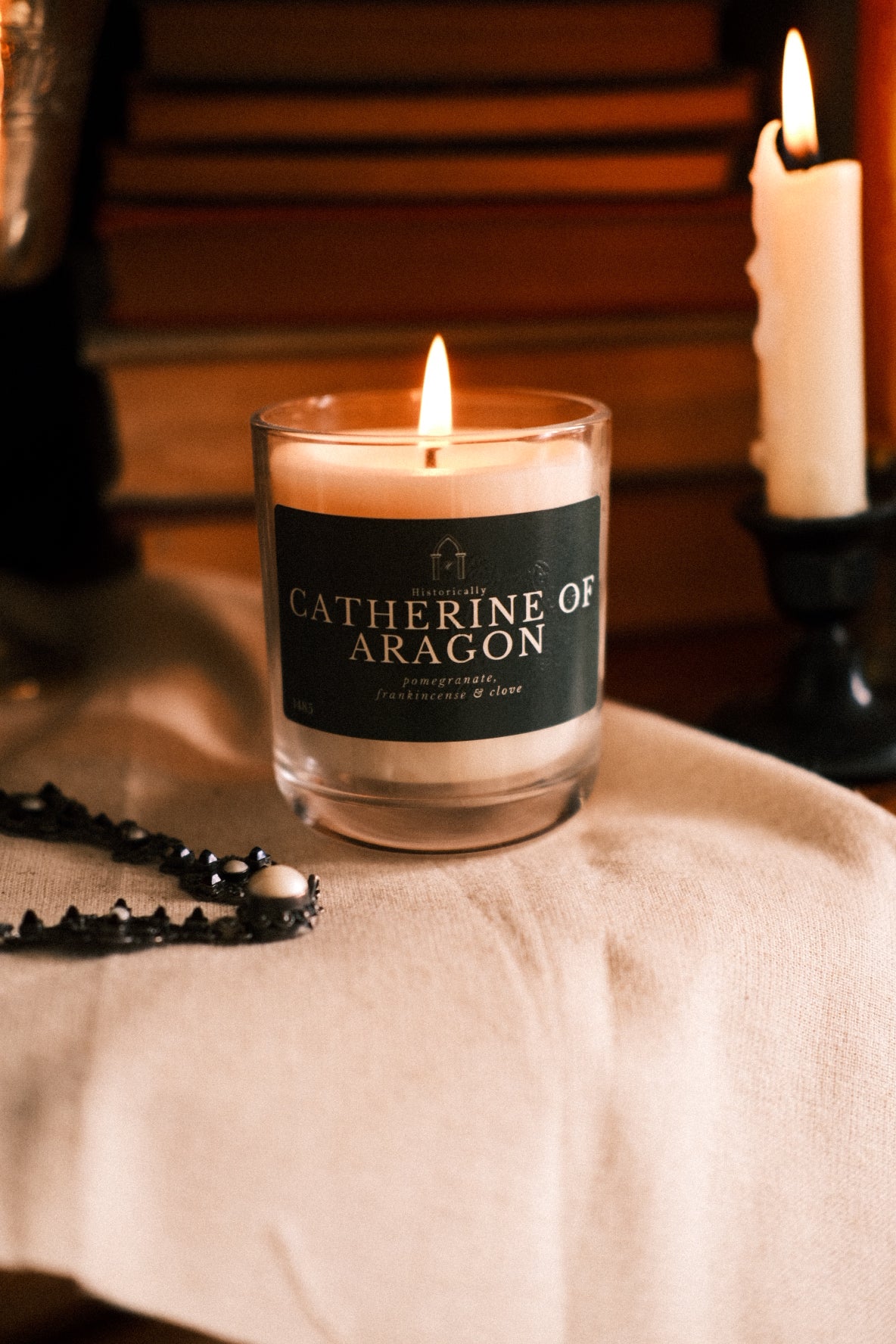
Catherine of Aragon, Spanish Princess and Henry VIII’s first wife, was a queen of fierce strength and dignity. Rich pomegranate, her emblem, bleeds into the air, bold and unwavering. Sacred frankincense whispers of her Catholic devotion, while smoldering clove recalls the steel of a queen who led England to victory at Flodden and became the first known female ambassador in European history. A scent of power, faith, and majesty.
170g/400g
Up to 40/100 hours of burn time
Recyclable glass vessel
100% Sustainable and natural soy wax
Essential Oil Blend
Vegan and free from animal cruelty
Made in the UK
Share
Scent Inspiration
Scent Inspiration
Inspired by the pomegrante, her symbol, this scent is bright, bold and passionate, indictive of her Spanish roots and Catholic faith.
History behind the Woman
History behind the Woman
Born in 1485 to Isabella I of Castile and Ferdinand II of Aragon, Catherine belonged to one of the most powerful royal families in Europe. Her parents had united the kingdoms of Castile and Aragon, completed the Reconquista, and established Spain as an emerging European power. Catherine received an exceptional education for a princess of her time, studying languages, history, theology, philosophy, and diplomacy. These accomplishments prepared her not simply to marry into another royal house, but to serve as an intelligent and capable queen.
Her journey to England began when she married Prince Arthur, the eldest son of Henry VII. The marriage was intended to strengthen the alliance between England and Spain, but tragedy struck only months later when Arthur died. Widowed in a foreign country at just sixteen years of age, Catherine faced years of uncertainty as negotiations continued over her future. Eventually, she married Arthur's younger brother, the future Henry VIII, in 1509 shortly after his accession to the throne.
The early years of their marriage appeared remarkably successful. Catherine was admired for her intelligence, generosity, and deep religious devotion. She embraced her responsibilities as queen with confidence, becoming an active patron of education, scholarship, and charitable works. Far from remaining in the background, she played an important role in government when required, demonstrating political ability that earned widespread respect.
One of Catherine's greatest achievements came in 1513 while Henry campaigned in France. Appointed Regent of England in his absence, she oversaw the kingdom during a time of military threat from Scotland. When King James IV invaded England, Catherine helped organise the nation's response, culminating in the English victory at the Battle of Flodden. James IV was killed in the fighting, securing one of England's most significant military victories of the Tudor period. Contemporary accounts suggest Catherine even sent Henry part of the fallen Scottish king's armour as a symbol of England's triumph, a remarkable testament to her resolve during a moment of national crisis.
Yet despite her many successes, Catherine's queenship became overshadowed by one heartbreaking reality. Although she experienced several pregnancies, only one child survived into adulthood, the future Mary I. The absence of a surviving son increasingly troubled Henry, whose concerns over the Tudor succession eventually led him to seek an annulment of their marriage.
Catherine refused to accept that her marriage had ever been invalid. She maintained that her union with Prince Arthur had never been consummated and insisted that she was Henry's lawful wife and England's rightful queen. Her refusal to yield transformed what began as a marital dispute into an international and religious crisis. When the papacy declined to grant Henry the annulment he desired, the king broke from Rome and established the Church of England, permanently altering the religious landscape of Britain.
Throughout the years that followed, Catherine endured separation from her daughter, the loss of her royal status, and increasing isolation. Yet she never abandoned the title of queen, nor did she publicly denounce Henry. Her quiet determination won admiration from many across England and Europe, who viewed her as a woman of exceptional integrity and unwavering faith. Even in adversity, Catherine maintained the composure and dignity that had defined her life from the beginning.
She died in 1536 at Kimbolton Castle, still believing herself to be Henry's true wife and England's rightful queen. Her funeral was conducted with the honours due to a Dowager Princess of Wales rather than a queen, yet the affection many held for Catherine remained undiminished. Her daughter Mary would later ascend the throne, restoring her mother's reputation and ensuring that Catherine's place in English history would never be forgotten.
Scent Notes
Scent Notes
pomegranate, frankincense & clove
Pomegranate:
Native to Persia and the eastern Mediterranean, the pomegranate has been cultivated since ancient times as both a fruit and a symbol of prosperity, fertility, and abundance. The Romans introduced pomegranates to Britain, although the climate prevented widespread cultivation. During the Tudor and Stuart periods, imported pomegranates became fashionable among wealthy households and frequently appeared in royal art and decoration, most famously as the emblem of Catherine of Aragon. By the Victorian era, improved trade made the fruit more readily available in Britain, where it was enjoyed fresh, preserved, and as an ornamental plant in conservatories.
Frankincense:
Frankincense, a resin obtained from Boswellia trees native to southern Arabia and northeast Africa, has been traded for more than 5,000 years. Revered in ancient Egypt, Greece, and Rome, it was burned in temples and used in medicine and perfumery. In Britain, frankincense became closely associated with Christian worship from the early medieval period onwards, imported for use in monasteries, cathedrals, and parish churches. Although its use declined after the Reformation, it experienced a revival during the 19th century through the Oxford Movement. Today, frankincense remains an important part of church liturgy in Britain and is widely used in perfumery and aromatherapy.
Clove:
Cloves, the dried flower buds of Syzygium aromaticum, are native to the Maluku Islands of Indonesia and have been traded internationally for over 2,000 years. They reached Britain through Roman and medieval trade routes and quickly became one of the country's most prized spices. In medieval Britain, cloves were used to flavour meats, preserve food, and prepare mulled wine, while apothecaries prescribed them for toothache and digestive complaints. British participation in the global spice trade during the 17th and 18th centuries made cloves more widely available, and today they remain an essential ingredient in traditional British baking, festive cooking, and spiced drinks.
Safety Information
Safety Information
Contains eugenol, CASHMERAN, Exaltolide. May produce an allergic reaction.

Frequently Asked Questions
Candle Care
I. Keep candles away from curtains, fabrics, furniture, and draughts.
II. Avoid placing candles under shelves; maintain a 3-foot (1-meter) clearance above.
III. Prevent contact with clothes and hair; place candles out of reach.
IV. Keep children and pets at a distance from candles.
V. Maintain at least 4 inches (10cm) between burning candles.
VI. Extinguish before moving; avoid objects falling into hot wax.
VII. Never leave burning candles unattended.
VIII. Safely extinguish with a snuffer or spoon, not by blowing.
IX. Double-check to ensure candles are completely out.
Delivery & Returns
Dispatch times
Our candles are made to order and most will take between 3-5 business days to dispatch but this can extend up to 7 business days during busy periods.
However, if you are wanting your order sooner or for a specific date please get in touch and we can sort something out for you!
Delivery Times
We currently offer standard delivery with Royal Mail Tracked 48 which should arrive between 2-3 days after dispatch and express delivery with Royal Mail Tracked 24 which should arrive between 1-2 days after dispatch.
Shipping outside the UK
We are unable to ship to the EU and USA at this time.
Please do get in contact with us if you would like an order delivered outside of the UK and we will let you know if this is possible and what shipping charges will be. If it is possible we will calculate the shipping costs for you and complete your order via invoice.
Please note that customers are responsible for paying any import VAT, taxes and fees.
What is your return policy?
Please note earrings cannot be returned and refunded for hygiene reasons.
We are happy to accept returns if you are unhappy with your purchase.
Contact us within 14 days of delivery
Dispatch items back within 30 days of delivery
Request a cancellation within 24 hours of purchase (this is only possible if you haven't recieved a dispatch email)
Buyers are responsible for return postage costs. If the item is not returned in its original condition, the buyer is responsible for any loss in value.
Item damaged in transit
Sometimes accidents happen.
If you receive a parcel that has been damaged in the post please send a picture to us showing the damage within 48 hours of your parcel being delivered and we can discuss options with you.