


Historically
Ada Lovelace
Ada Lovelace
Couldn't load pickup availability
The First Computer Programmer.
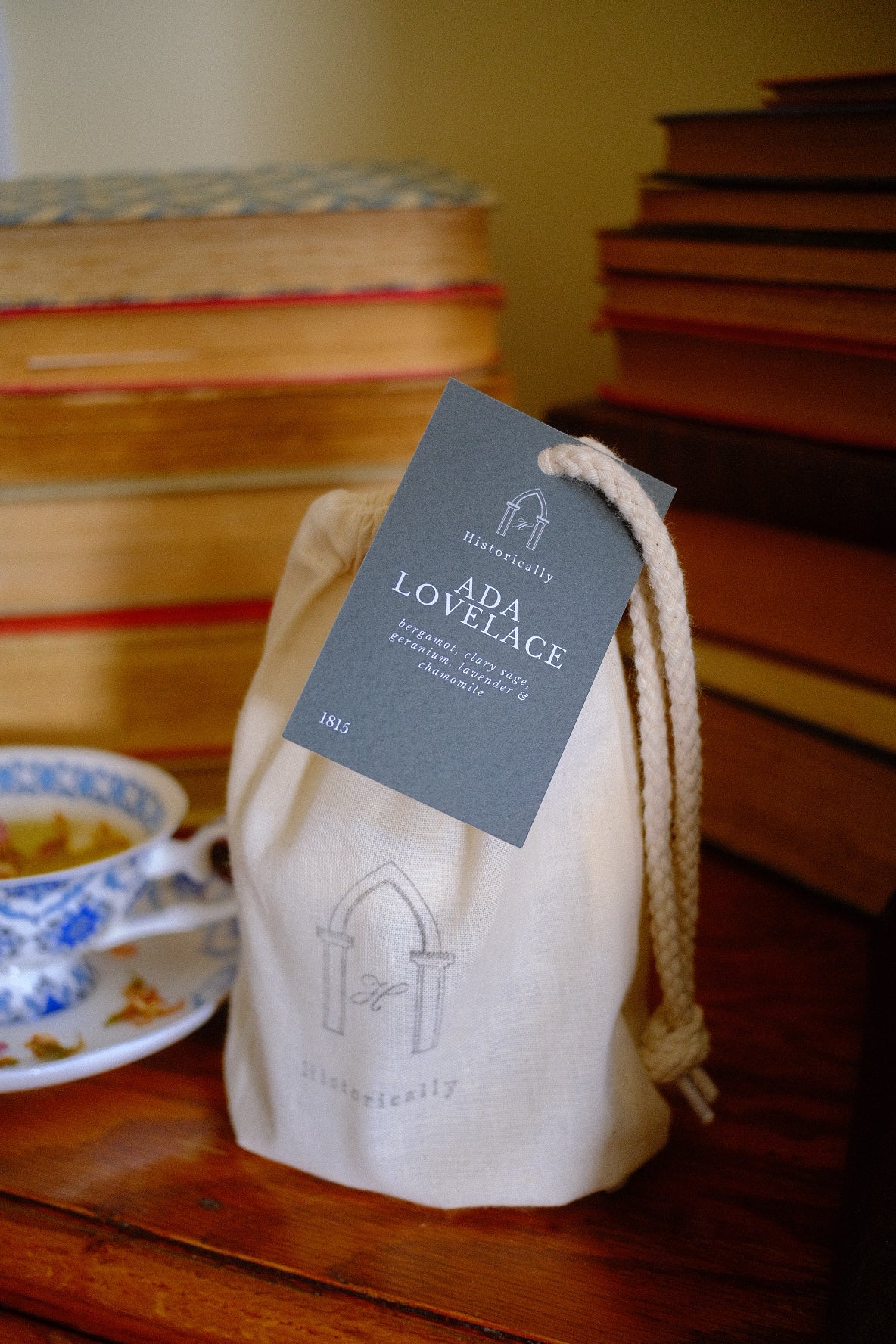
Embark on an odyssey of logic and imagination, inspired by Ada Lovelace, the world's first computer programmer. Her scent intertwines vibrant notes of bergamot and grounding clary sage, mirroring the elegance of her groundbreaking equations. Soothing chamomile and serene lavender evoke the harmony of her creative spirit, while geranium adds a flourish of innovation, embodying a fragrant symphony of intellect and artistry.
160g/400g
Up to 40/100 hours of burn time
Recyclable glass vessel
100% Sustainable and natural soy wax
Essential oil blend
Vegan and free from animal cruelty
Made in the UK
Share
Scent Inspiration
Scent Inspiration
Whilst there are no records of what perfume Ada Lovelace wore, delicate, floral and understated scents were popular during the early Victorian period.
We have chosen subtle florals of chamomile, geranium and lavender representing her creative spirit whilst clary sage grounds the scent like her skillfull interllect.
At this time it is also highly unlikely that she would have worn any scent on her skin, instead perfumes were worn on hankerchiefs, gloves and pomanders.
History behind the Woman
History behind the Woman
Few historical figures have bridged the worlds of imagination and science as remarkably as Ada Lovelace. Writing and thinking during the early Victorian period, Ada lived at a time when mathematics, engineering, and industry were transforming society. Yet while many of her contemporaries viewed calculating machines simply as tools for arithmetic, Ada envisioned something far more extraordinary. Her ideas anticipated concepts that would not become reality for more than a century, earning her recognition today as one of the earliest pioneers of computer science.
Born in 1815, Ada was the only legitimate child of the celebrated poet Lord Byron and his wife Anne Isabella Milbanke. Her parents separated only weeks after her birth, and Ada would never truly know her father, who left England and died when she was still a child.
Her mother, often known as Annabella, was determined that her daughter should receive an education grounded in logic and reason. Concerned that Ada might inherit what she viewed as Byron’s unpredictable temperament, she encouraged rigorous study in mathematics and science. This decision was highly unusual at a time when most girls received only a limited education focused on accomplishments considered suitable for society.
As a result, Ada developed intellectual interests rarely available to women of her generation. She studied mathematics with some of the leading scholars of the day and demonstrated a remarkable aptitude for complex ideas. Yet she never viewed science and imagination as opposing forces. Instead, she believed they worked together, a philosophy she would later describe as “poetical science.”
This combination of analytical ability and creative thinking became the defining feature of her work.
A pivotal moment came in 1833 when Ada met Charles Babbage, the mathematician and inventor often called the father of the computer. Babbage had designed a machine known as the Difference Engine, intended to perform mathematical calculations automatically. Ada was fascinated by his ideas and quickly established a friendship with him based on mutual intellectual respect.
Babbage later developed plans for an even more ambitious device known as the Analytical Engine. Unlike earlier calculating machines, the Analytical Engine was designed to be programmable. It could, in theory, perform a wide range of operations rather than being limited to a single task.
The machine was never completed during Babbage’s lifetime, largely due to financial and engineering challenges. Yet Ada recognised its significance immediately.
In 1842, an Italian engineer named Luigi Menabrea published a description of the Analytical Engine. Ada translated the work into English, but her contribution went far beyond translation. She added extensive notes of her own, ultimately producing a document that was considerably longer than the original article.
Within these notes lay the achievement for which she is most famous today.
Ada described a method by which the Analytical Engine could calculate a sequence of numbers known as Bernoulli numbers. In modern terms, this is often regarded as the first published computer program. Although no computer existed to run it, Ada had effectively outlined a sequence of instructions for a machine to follow.
More remarkable still was her understanding of the machine’s broader potential. Many people saw the Analytical Engine merely as an advanced calculator. Ada imagined something much more revolutionary.
She suggested that a machine could manipulate symbols as well as numbers. If information could be represented mathematically, she reasoned, then a machine might one day create music, process language, or perform tasks far beyond arithmetic.
This was an astonishing insight for the 1840s. More than a century before the development of modern computers, Ada Lovelace envisioned machines capable of functions that now underpin everyday life.
Her ideas were so far ahead of their time that they received little recognition during her lifetime. Victorian society offered few opportunities for women to establish careers in science, and many of her contributions remained overshadowed by the work of Babbage.
Yet those who knew her recognised her brilliance. Babbage himself admired her intellect and referred to her as the “Enchantress of Numbers,” a title that captured both her mathematical talent and her imaginative approach to scientific inquiry.
Ada’s life was not without difficulty. She struggled with periods of ill health throughout adulthood and faced personal and financial challenges. Despite these obstacles, she continued pursuing intellectual interests and maintained correspondence with scientists, mathematicians, and thinkers.
Tragically, her life was cut short. Ada Lovelace died in 1852 at the age of just thirty six. Like many pioneering figures, she did not live to see the full significance of her ideas.
For decades after her death, her work remained relatively obscure. It was only during the twentieth century, as electronic computers began to emerge, that historians and scientists revisited her writings. They discovered that many of her insights anticipated concepts central to modern computing.
Today Ada Lovelace is celebrated as one of the most important figures in the history of technology. Her name has been given to programming languages, educational initiatives, and international celebrations that encourage women to pursue careers in science, technology, engineering, and mathematics.
What makes Ada Lovelace’s legacy particularly compelling is that she understood something many others did not. She recognised that technology is not merely about machinery. It is about possibility. She saw that machines could become tools for creativity, communication, and discovery.
In many ways, the digital world of today reflects the future she imagined. Computers now create music, generate images, process language, and connect people across the globe. These possibilities can be traced back to ideas she articulated nearly two centuries ago.
In the history of science and technology, few voices were as visionary. Though she lived in the Victorian age, Ada Lovelace saw further into the future than almost anyone around her, securing her place as one of the most extraordinary women in history.
Scent Notes
Scent Notes
Bergamot, clary sage, geranium, lavender & chamomile
Clary Sage:
Clary sage (Salvia sclarea), native to the Mediterranean, North Africa, and Central Asia, has a rich history of medicinal, spiritual, and culinary use dating back to ancient times. The Greeks and Romans were among the first to document its healing properties, especially for eye conditions, calling it "Clear Eye" or "Oculus Christi." During the Middle Ages, it was cultivated in monastic gardens across Europe for its digestive and menstrual remedies, and also held magical significance as an aphrodisiac and protector against evil. In the Renaissance, herbalists like John Gerard praised its effectiveness in treating eye ailments, and it was used as a hops substitute in beer brewing. By the 18th and 19th centuries, clary sage became a key ingredient in perfumes and essential oils, valued for its calming effects in aromatherapy and folk medicine. Throughout its history, clary sage has been symbolically associated with healing, insight, and vision, embodying both physical and spiritual clarity.
Lavender:
Lavender, prized for its soothing scent and versatility, has a history reaching back millennia, likely originating in the Mediterranean. Ancient civilizations like the Egyptians and Greeks appreciated its worth, with its name stemming from the Latin "lavare," meaning "to wash." Romans, in particular, cherished lavender, using it in their baths for relaxation. They introduced lavender to Great Britain during their occupation, sowing the seeds of its popularity. Over time, it spread across Europe, becoming a garden favorite and finding use in perfumes, potpourri, and remedies. In England, lavender's presence grew, adorning gardens and serving culinary and medicinal purposes. Today, English lavender fields, like those in the Cotswolds and Norfolk, are beloved for their beauty and fragrant allure, symbolizing history and aromatic appeal.
Safety Information
Safety Information
Contains Eucalyptol, beta-Caryophyllene, d-Limonene.
May produce an allergic reaction.


Frequently Asked Questions
Candle Care
I. Keep candles away from curtains, fabrics, furniture, and draughts.
II. Avoid placing candles under shelves; maintain a 3-foot (1-meter) clearance above.
III. Prevent contact with clothes and hair; place candles out of reach.
IV. Keep children and pets at a distance from candles.
V. Maintain at least 4 inches (10cm) between burning candles.
VI. Extinguish before moving; avoid objects falling into hot wax.
VII. Never leave burning candles unattended.
VIII. Safely extinguish with a snuffer or spoon, not by blowing.
IX. Double-check to ensure candles are completely out.
Delivery & Returns
Dispatch times
Our candles are made to order and most will take between 3-5 business days to dispatch but this can extend up to 7 business days during busy periods.
However, if you are wanting your order sooner or for a specific date please get in touch and we can sort something out for you!
Delivery Times
We currently offer standard delivery with Royal Mail Tracked 48 which should arrive between 2-3 days after dispatch and express delivery with Royal Mail Tracked 24 which should arrive between 1-2 days after dispatch.
Shipping outside the UK
We are unable to ship to the EU and USA at this time.
Please do get in contact with us if you would like an order delivered outside of the UK and we will let you know if this is possible and what shipping charges will be. If it is possible we will calculate the shipping costs for you and complete your order via invoice.
Please note that customers are responsible for paying any import VAT, taxes and fees.
What is your return policy?
Please note earrings cannot be returned and refunded for hygiene reasons.
We are happy to accept returns if you are unhappy with your purchase.
Contact us within 14 days of delivery
Dispatch items back within 30 days of delivery
Request a cancellation within 24 hours of purchase (this is only possible if you haven't recieved a dispatch email)
Buyers are responsible for return postage costs. If the item is not returned in its original condition, the buyer is responsible for any loss in value.
Item damaged in transit
Sometimes accidents happen.
If you receive a parcel that has been damaged in the post please send a picture to us showing the damage within 48 hours of your parcel being delivered and we can discuss options with you.